


By Adrian Corish, Founder, African Migration Advisory Centre (AMAC)
When numbers stop being just numbers and start telling uncomfortable truths, we should pay attention. The 2025 WASSCE results are doing just that for The Gambia. This isn’t just a report card for our schools; it’s a warning signal for our entire nation.
A Gender Gap That’s More Than Just a Statistic
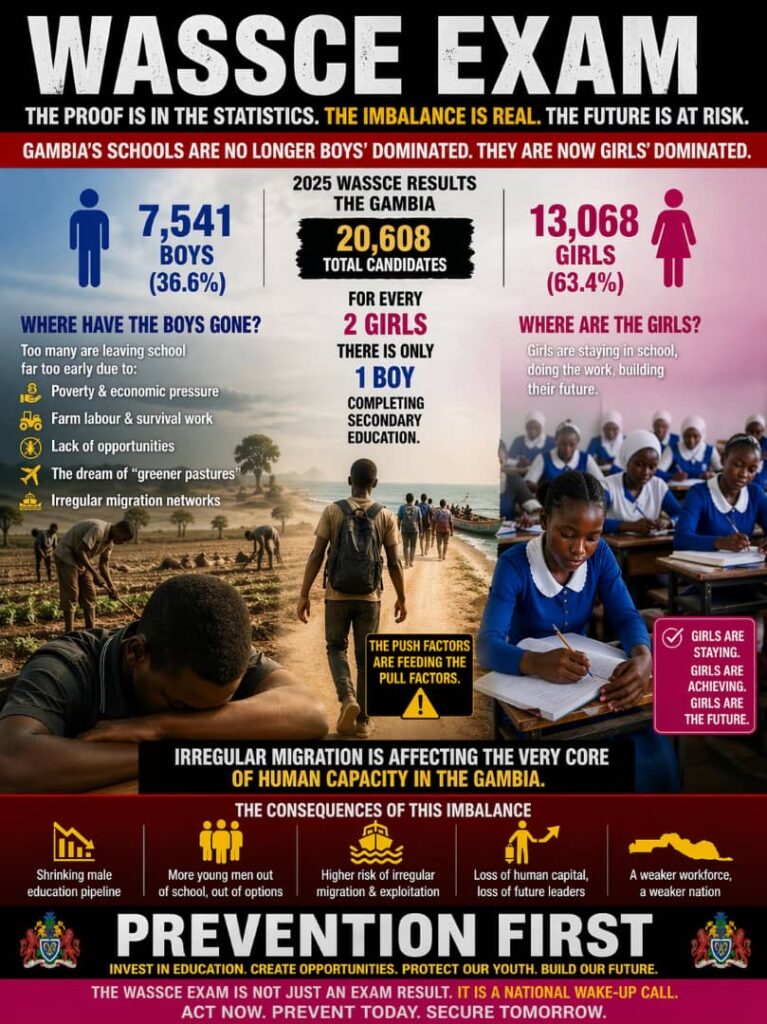
This year, 20,608 Gambian students sat for the WASSCE. Sixty-three percent of them were girls. Only thirty-seven percent were boys. That’s not a small gap. It’s a chasm. For every boy finishing secondary school, there are almost two girls.
People will say gender gaps in education happen everywhere, and they’re right. But the scale of this one begs a deeper question: why are our boys disappearing from the education system?
Who Stays, Who Leaves, and What That Means
The exam numbers aren’t just a score sheet. They’re a map of who makes it to the end of school — and who doesn’t. The story is clear: Gambian girls are staying in school longer and finishing in greater numbers than boys. Boys are dropping out earlier, and the pipeline for male education is narrowing.
This is more than a footnote. It’s a shift that could quietly reshape society, leaving more young women prepared for the formal economy, while too many young men are left behind.
Why Are Boys Falling Away?
If you ask around — in villages, on the edge of towns, in markets — the reasons are painfully familiar. Economic hardship pushes families to pull boys out of school to help with farming or find quick work. For some, the dream of opportunity abroad, fueled by stories online or from friends, makes staying in school seem pointless. In too many places, boys come to see education as a dead end, not a way out.
The Real Risk: A Country Divided
This isn’t just an education problem. It’s the early warning of deeper economic and social divides. When boys drop out, they don’t just disappear. They join a growing pool of youth with few options: informal jobs, risky migration routes, or worse, the grip of smuggling networks. Meanwhile, a different group — mostly young women — continues in school, chasing the promise of something better. Two Gambias are emerging, side by side.
The Shadow of Migration
It’s no secret that boys who leave school early are at much higher risk of irregular migration. They’re drawn into unstable jobs, easy promises from smugglers, and the dangerous pull of the Atlantic route. This is not just theory; it’s playing out across West Africa, and we’re seeing it here.
And the economics are stacked against us. Smuggling operations are fast, profitable, and always one step ahead. Prevention — whether through law, education, or community programs — is slow and underfunded. Most of our interventions happen after a boy is already on his way out.
Prevention Starts Early
We know the answer, even if we keep ignoring it. The only way to slow the tide of irregular migration is to invest upstream: keep kids, especially boys, in school. Build real job pathways. Support communities before desperation sets in.
That takes more than speeches. It takes real coordination between The Gambia and the countries our youth dream of reaching. It means making education relevant, creating jobs that feel real, and listening to the signals our own data is sending.
This Is About Our Future
The 2025 WASSCE results are not just about who passed or failed. They’re about the kind of country we’re becoming. If we let our education system split along gender lines, and if we keep leaving so many young people without options, we shouldn’t be surprised when migration pressure grows. That won’t be a tragedy — it’ll be the inevitable outcome of choices we made, or failed to make.
The question isn’t just about this year’s exam. It’s about what kind of Gambia we want, and what we’re willing to do to get there.
Contact: adriancorish@amacthegambia.org | www.amacthegambia.org