

By Adrian Corish, Founder, Africa Migration Advisory Centre (AMAC)
Every year, thousands of young West Africans risk everything to reach Europe, crammed onto boats bound for the Canary Islands. Each journey is a tragedy in the making, and yet the system that fuels these departures remains largely untouched. Today, I am making a direct and urgent appeal to the Governments of The Gambia and Spain: address the structural imbalance that keeps the Atlantic migration route open — and deadly.
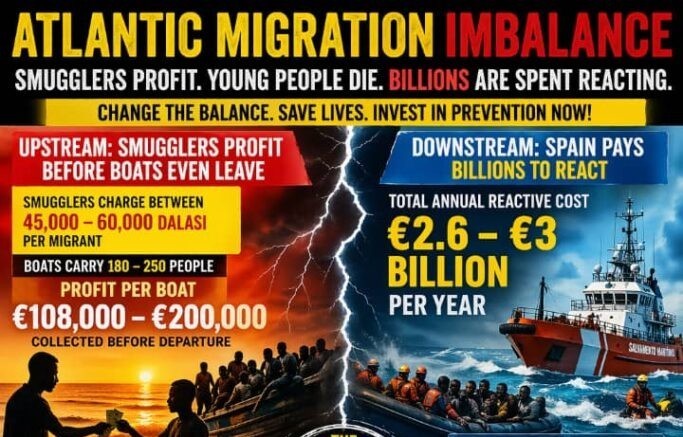
Let’s be honest about who profits and who pays. Smuggling networks along the West African coast are thriving, collecting between 45,000 and 60,000 Dalasi from every desperate migrant who boards a boat. With each vessel carrying anywhere from 180 to 250 people, smugglers rake in as much as €200,000 before the boat ever leaves shore. This money is pocketed long before any rescue mission, interception, or return flight comes into play.
Meanwhile, the real financial pain is felt not in Banjul or Dakar, but in Madrid. Once a boat makes it to the Canary Islands, Spain’s well-oiled response machinery kicks in: search and rescue, border surveillance, reception centers, asylum processing, detentions, returns, emergency care. It all adds up — to the tune of €2.6 to €3 billion per year. That’s billion, not million.
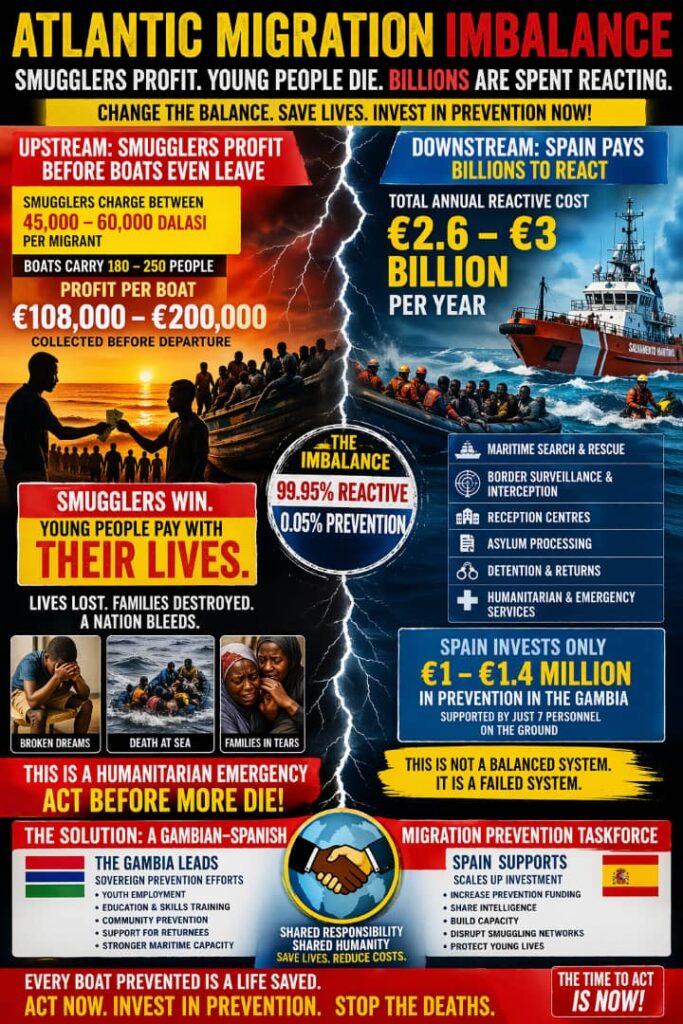
Now, here’s the kicker: for all this downstream spending, Spain’s current “prevention” presence in The Gambia consists of about seven staff, tasked with liaison and coordination. If you add up the costs — salaries, security, housing, logistics — you get an annual investment of roughly €1 to €1.4 million. That’s less than the revenue from just a handful of migrant boats. In percentage terms, Spain is spending 99.95% of its migration budget reacting to boats that have already arrived, and only 0.05% on preventing them from leaving in the first place.
This is not just inefficient, it’s indefensible. Billions are poured into the back end, while the front end — where departures can actually be stopped — is left starved for resources. Smuggling rings thrive on this imbalance, collecting their money and sending more boats, while Spanish taxpayers foot the bill and our young people keep dying at sea.
Gambian authorities aren’t blind to this crisis; they’re working hard to intercept departures and disrupt smuggling. But let’s be real: no amount of enforcement can keep up with the sheer scale and profit of the trade unless there’s meaningful investment in prevention, livelihoods, and alternatives for our youth.
It’s time for a reset. I am calling for the creation of a Spain-Gambia Migration Prevention Taskforce — one where The Gambia leads sovereign prevention efforts, and Spain matches its downstream spending with real upstream investment. Both countries must share the responsibility to reduce deaths on the Atlantic route, because the numbers don’t lie: if we keep underfunding prevention, more people will come, more will die, and the bills will keep mounting.
If we shift even a small fraction of those billions to prevention, we save lives and money. Let’s stop rewarding smugglers and start investing in hope, dignity and real solutions on both sides of the Atlantic.
Adrian Corish
Founder, Africa Migration Advisory Centre (AMAC)
www.amacthegambia.org
Email: adriancorish@amacthegambia.org