

By Adrian Corish, Founder/Director (AMAC)
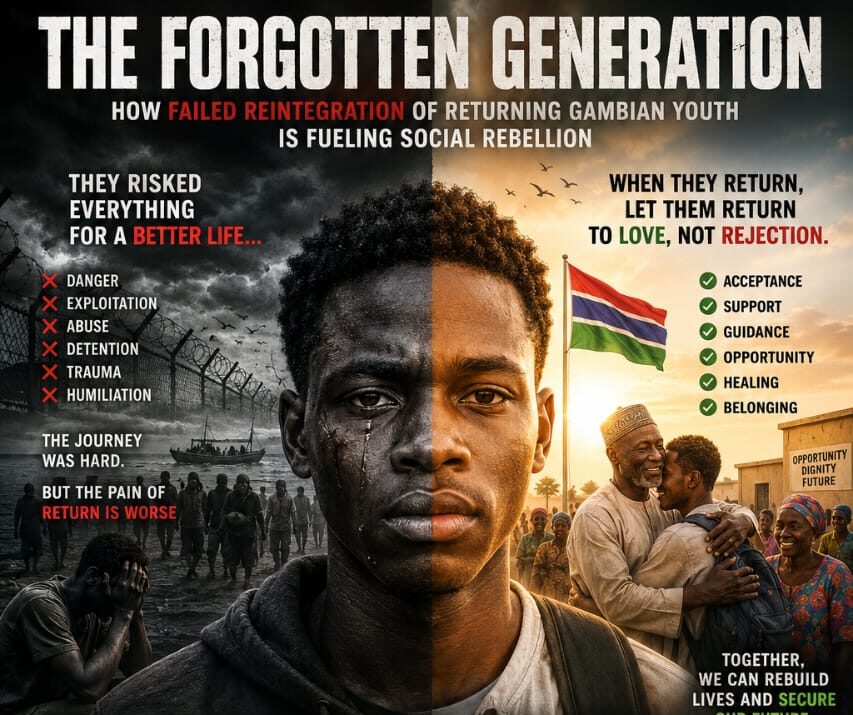
There’s a quiet crisis brewing across The Gambia—one that doesn’t announce itself with headlines or speeches, but creeps in through silence. It’s the struggle of young people returning home after the “backway”—that dangerous path so many take, chasing hope in distant lands, only to come back carrying scars no one wants to talk about. And too often, they return to a country that doesn’t know what to do with them.
We like to say that family is everything here. That our communities are our safety nets, our source of strength. But for a growing number of returnees, that net has holes. Instead of a warm welcome, some come home to disappointment and suspicion. The questions start before the bags are even unpacked: “Why are you back?” “Did you make it?” “What did you bring?” Rarely: “Are you alright?”
Let’s be honest. The backway is not just a road; it’s a gamble. Families sell land, borrow money, pin their dreams on one child making it abroad. When that child comes back with empty pockets, it’s not just money that’s lost—it’s pride, trust, sometimes even love. The young person, already bruised by trauma—detention, hunger, exploitation—now carries a new burden: the feeling that they’ve let everyone down.
But this is where we get it wrong, as a society. Coming home is not failure. Turning our backs on those who return—that’s failure. A returnee is not a problem to hide. They’re someone who needs support, dignity, a place to belong.
Too often, our reintegration efforts look like quick fixes: a little cash for a business, some training, maybe a loan. These things matter, of course. But if we don’t address the invisible wounds—shame, grief, isolation—then we’re just papering over cracks. What’s needed is something deeper: family reconciliation, mental health care, spaces where returnees can talk, be heard, and be guided back into community life.
If we ignore these needs, we shouldn’t be surprised when frustration boils over. When young people drop out, drift, or rebel, it’s not because they’re “bad”—it’s because they feel abandoned. And when enough feel abandoned, society itself grows brittle. The violence we see on our streets, the rise of aggressive youth groups—these are not just problems for the police. They are warning signs that something is broken at the roots.
So what do we do? We start by seeing every returnee not as a statistic, but as someone’s son, someone’s daughter—a story waiting to be written, not thrown away. We need a national reintegration strategy, one that brings together families, communities, government, civil society, and yes, returnees themselves. It means investment in mental health, in real job opportunities, in community acceptance. It means mentorship programs led by returnees who have rebuilt their lives. It means refusing to let any young Gambian feel like a stranger at home.
Here’s the truth: the future of The Gambia isn’t just about stopping dangerous migration. It’s about what happens after the journey ends. Will we welcome our children back and help them heal? Or will we let them drift, lost between two worlds?
Reintegration is not charity. It’s national security. It’s social protection. It’s an investment in peace.
If we want to protect our future, we must start by welcoming our children home—not just with open arms, but with open hearts.
Adrian Corish is the Founder/Director of AMAC. www.amacthegambia.org