
BIJILO — The National Human Rights Commission (NHRC) has renewed its call for the Independent Electoral Commission (IEC) to put arrangements in place for Gambians abroad to vote, saying they should not be excluded from elections because they live outside the country.
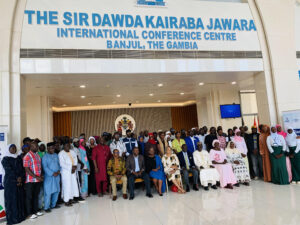
NHRC Chairman Emmanuel Daniel Joof made the call at a diaspora engagement forum held on Saturday, 31st October 2026, at the Sir Dawda Kairaba Jawara International Conference Centre (SDKJ-ICC) in Bijilo. He said the Commission had raised the issue with the IEC, the Ministry of Justice and other stakeholders, but the arrangements needed to enable voting from abroad had yet to be put in place.
“We have engaged the IEC before and the Ministry of Justice and others regarding the right of diasporans to vote. We have never been quiet, we have never been shy about it,” Joof said.
“The diaspora, they have a right to vote. It’s there. They have a constitutional right, we have a court decision on this area, and we are pushing the IEC to make sure that the tools that are necessary for diasporans to vote are in place,” he said.
A 2021 Supreme Court ruling affirmed the right of Gambians living abroad to register and vote in presidential, National Assembly and local government elections, as well as referenda. In March 2025, the National Assembly voted to remove Clause 14 of the Elections Bill 2021, which sought to provide for the registration of Gambians residing abroad. Gambians overseas still have to return home to take part in voter registration and elections.
Joof said the exclusion was especially troubling given the diaspora’s contribution to national development. “If you have a group of people, a group of Gambians who are contributing to national development, you cannot disenfranchise them,” he said.
He added that those contributions go beyond remittances. Gambians abroad also bring professional expertise, skills and international experience, he said, calling for a more structured partnership between the diaspora and national institutions. Joof urged participants to accept divergent views and dissent as part of democracy, rather than treating Gambians at home and abroad as opposing groups.
More than 40 Gambians abroad joined the forum virtually. Government representatives, civil society organisations and professionals also took part in discussions on governance, democratic processes, transitional justice, security sector reform, human rights and electoral participation.
UNDP Country Representative in The Gambia Mandisa Mashologu commended the NHRC and its partners for convening the forum. She said the diaspora’s expertise, professional networks, investment potential and lived experiences could contribute to the country’s peace, democratic development and economic prosperity.
Mashologu called for credible mechanisms that would allow Gambians abroad to contribute their skills and resources consistently. She also stressed the need to align diaspora participation with Yiriwaa and the Sustainable Development Goals, and to follow the discussions with practical action.
In her keynote address, TANGO Chairperson Yadicon Njie Eribo described the diaspora as one of The Gambia’s most significant development partners.
“When we speak about national development, we often focus on government revenue, foreign direct investment, development assistance, and private sector growth,” she said. “However, one of The Gambia’s most significant development partners is a constituency whose contribution is sometimes acknowledged, but not significantly harnessed. That is our diaspora.”
Citing World Bank data, Njie Eribo said personal remittance inflows to The Gambia had reached approximately US$872.5 million. She said those funds help pay school fees and healthcare costs, sustain small businesses and support households across the country. The challenge, she added, is to create more opportunities for diaspora resources to support productive investment, jobs and long-term economic activity.
Participants also called for transparency, access to information and accountability in dealings between the diaspora and national institutions. The forum forms part of a series of nationwide engagements supported by the European Union through the UNDP GREAT Project, aimed at strengthening dialogue between duty bearers and rights holders.