

By Lamin S Jaiteh
The Alliance for Patriotic Reorientation and Construction is approaching the December 2026 presidential election as a party divided against itself.
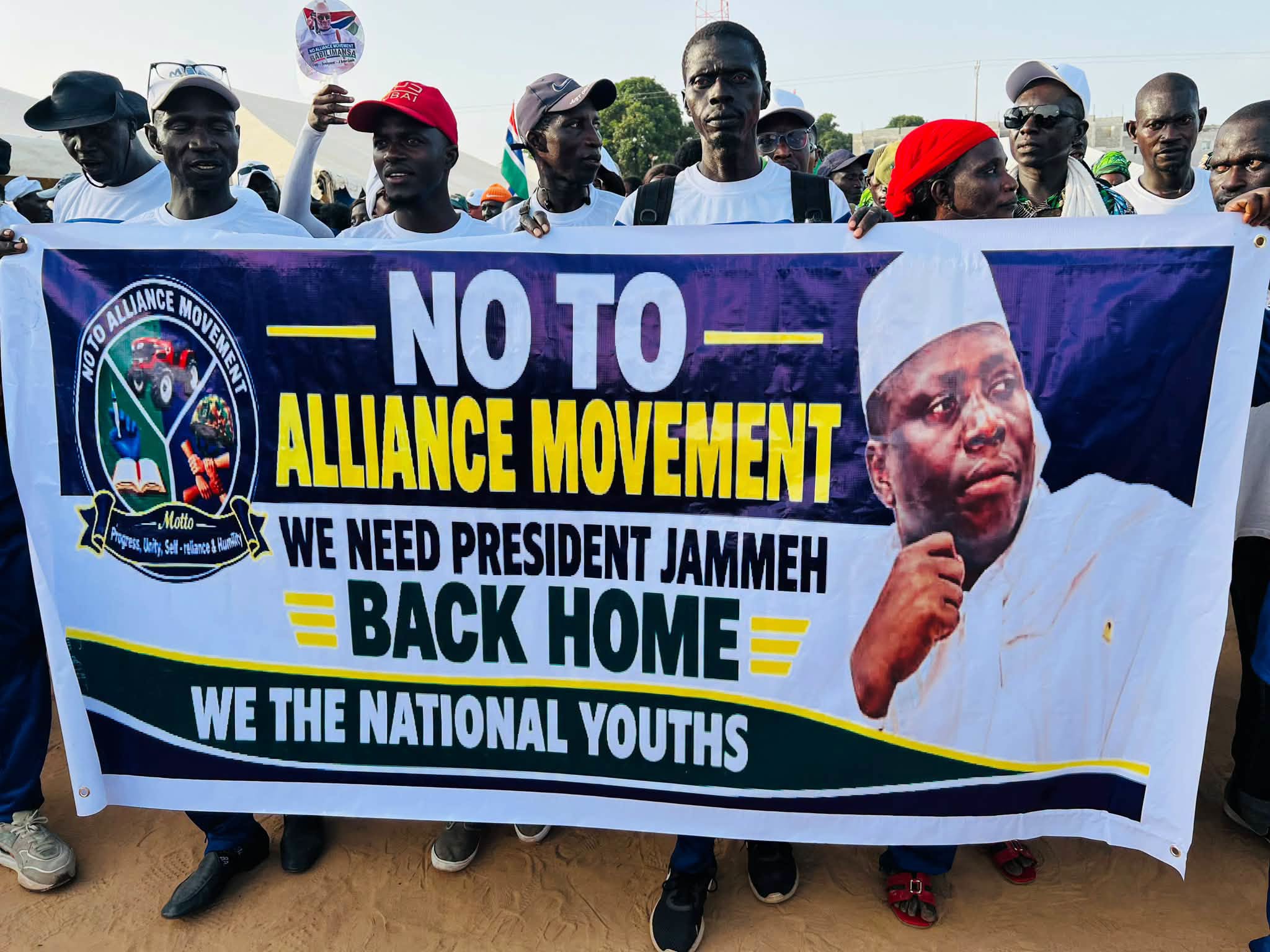
On one side stands the APRC leadership recognised by the Independent Electoral Commission, led by Fabakary Tombong Jatta and allied with President Adama Barrow’s National People’s Party. On the other is the No to Alliance Movement, loyal to former president Yahya Jammeh and now led electorally by Foni Kansala parliamentarian Almameh Gibba.
This is more than the usual quarrel over offices and titles. It is a struggle over who speaks for the APRC tradition, who commands Jammeh’s remaining political constituency and where those votes will go on 5 December.
The dispute dates back to the APRC leadership’s 2021 decision to form an alliance with the NPP. Jammeh rejected that agreement from exile, denounced it as illegitimate and attempted to dismiss party officials who supported it. The IEC continued to recognise the Fabakary Tombong Jatta leadership, while Jammeh’s followers organised themselves around the No to Alliance cause. That fracture has never healed.
What has changed is the scale of the challenge. No to Alliance is trying to move beyond protest and nostalgia to become an organised electoral force. At its formal launch, its leaders said the movement was entering a new phase of participation in the 2026 presidential and subsequent elections. They also pointed to their performance in Foni, where the movement says it secured all five National Assembly seats and seven council seats.
Those results matter. A political movement capable of winning elected positions cannot simply be dismissed as noise from Jammeh’s past.
A dangerous weakness in the APRC–NPP arrangement
The APRC–NPP alliance gave the recognised APRC leadership access to government and a place within Barrow’s governing coalition. It also gave the NPP an opening into a constituency that had remained deeply attached to Jammeh.
Yet the alliance contained a contradiction from the beginning. The recognised APRC leadership possessed the party’s legal machinery, but Jammeh retained considerable emotional authority among many grassroots supporters. The arrangement therefore depended on an assumption that party structures and government appointments would gradually outweigh personal loyalty to the former president.
That assumption now looks increasingly doubtful.
Jammeh has continued to intervene in Gambian politics from Equatorial Guinea through recorded messages and social-media channels. He has directed rallies, dismissed factional officials and challenged the authority of APRC leaders who rejected his instructions. His decisions have not always been consistent, but his capacity to command attention remains difficult to deny. As The Fatu Network reported, his interventions have repeatedly reshaped the leadership of the faction loyal to him.
The resurgence of No to Alliance threatens the NPP partnership in three ways.
First, it weakens the claim that the recognised APRC leadership can deliver the Jammeh vote to Barrow. A party alliance has limited electoral value if the voters it claims to represent are following somebody else.
Second, it creates a powerful identity contest. No to Alliance can portray itself as the authentic defender of the APRC’s history, while casting the official leadership as a group that exchanged principle for access to power. Whether that accusation is fair is almost beside the point. In politics, a charge becomes dangerous when it matches what a significant part of the base already feels.
Third, it gives the opposition another route into Foni and the wider former-APRC constituency. Gibba has called on opposition parties to cooperate in removing the Barrow government and declared that his movement’s door is open to a coalition . If such cooperation becomes credible, the NPP may lose votes it once expected to receive through its agreement with the APRC.
This does not mean the APRC–NPP alliance will immediately collapse. The recognised APRC leadership still has legal status, organisation and the advantages that come with participating in government. But the alliance may survive formally while becoming electorally hollow. That is the greater danger.
How relevant is No to Alliance?
No to Alliance is relevant, but its relevance must be measured carefully.
It is not yet clear that the movement can independently win a national presidential election. Its strongest demonstrated support lies in Foni, and a national contest requires organisation, agents, financing and credible structures across the country. Loyalty to Jammeh may mobilise committed supporters, but it does not automatically produce a national majority.
Its importance lies elsewhere: it may possess enough support to influence who wins.
The 2026 presidential election is scheduled for 5 December, with President Barrow seeking another term amid a fragmented opposition. Under such conditions, a concentrated bloc of voters can carry more weight than its national size suggests. No to Alliance could deny Barrow votes, strengthen an opposition coalition or field a candidate whose presence changes the electoral arithmetic.
The movement’s name also disguises an important change. “No to Alliance” began as opposition to one specific alliance: the APRC partnership with the NPP. It no longer appears to mean opposition to every political partnership. Gibba has said the group is open to cooperation with opposition parties, while earlier reporting indicated that its conditions could include Jammeh’s return to The Gambia.
That creates both an opportunity and a credibility problem.
The opportunity is that NAM can become a negotiating bloc rather than an isolated faction. The problem is that voters may ask why a movement founded against an alliance now wants another alliance. Its leaders will need to explain that distinction plainly: they opposed alignment with Barrow, not cooperation in principle.
If they fail to do that, opponents will accuse them of political convenience. If they succeed, they may persuade supporters that coalition-building is a practical route to ending NPP rule.
Why Jammeh chose Almameh Gibba
Jammeh’s decision to hand the electoral baton to Almameh Gibba appears to be driven by necessity, political calculation and succession planning.
Jammeh remains in Equatorial Guinea and cannot run an effective national campaign from exile. His possible return is politically and legally sensitive. The Truth, Reconciliation and Reparations Commission recommended prosecution for alleged abuses committed during his rule, and the government accepted recommendations relating to prosecution. Any immediate return could therefore trigger consequences far beyond electoral politics.
He needs someone inside The Gambia who can campaign, negotiate, speak in Parliament and turn personal loyalty into an organised political structure.
Gibba offers several advantages. He is an elected National Assembly member from Foni Kansala, placing him at the centre of Jammeh’s strongest remaining base. He has public visibility and a platform from which to challenge the government. He can also present himself as a bridge between the old APRC constituency and a younger political generation.
His prominence in NAM’s formal launch was no accident. Gibba read Jammeh’s launching address, set out the movement’s ambitions and said it intended to move from resistance to organised participation. Jammeh later selected him as the movement’s flagbearer ahead of the December election.
There is also a strategic reason. By selecting a sitting parliamentarian rather than another older APRC official, Jammeh can claim that the movement is renewing itself without surrendering control of its political direction. Gibba supplies domestic presence and democratic legitimacy; Jammeh supplies the name, emotional connection and loyal following.
Still, it is too early to call this a complete transfer of power. Jammeh appears to have delegated candidacy and day-to-day leadership, not necessarily surrendered final authority. Gibba’s real test will come when he must make a decision that Jammeh’s supporters dislike—or when coalition negotiations require compromise.
A candidate who needs approval from Equatorial Guinea for every major move will struggle to convince Gambians that he is an independent national leader. If Gibba is to grow beyond Foni, he must become more than Jammeh’s representative. He will need to explain what he stands for in his own right.
The burden on all sides
The recognised APRC leadership now faces an uncomfortable choice. It can continue treating No to Alliance as an illegitimate splinter group, or it can acknowledge that the rebellion reflects a real crisis of confidence within the party’s traditional base.
Insults and expulsions will not settle that crisis. Neither will appointments alone.
The NPP must also reassess what its alliance actually provides. If the arrangement delivers officials but not voters, President Barrow may find that he has inherited the costs of association with the APRC without receiving its full electoral benefit.
For No to Alliance, the challenge is different. Jammeh’s name can mobilise supporters, particularly in Foni, but it also carries the unresolved burden of his 22-year rule. A movement that speaks only about restoring Jammeh’s influence will find it difficult to broaden its appeal among Gambians who associate that period with repression and fear.
NAM has announced a programme centred on progress, unity, self-reliance and humility, with proposals involving agriculture, healthcare, education, security and infrastructure. Those commitments must now become clear and realistic policies. Voters deserve more than an argument about who betrayed whom in 2021.
The movement must also avoid turning Jammeh’s possible return into the sole condition for political cooperation. The 2026 election should be about how Gambians will live, work and govern themselves—not simply about the fate of one former president.
An electoral force that cannot be ignored
No to Alliance is unlikely to replace the APRC’s recognised leadership merely by claiming Jammeh’s blessing. Legal recognition, party structures and nationwide organisation still matter.
But it would be equally foolish to dismiss the movement as a minor faction. Its elected representation in Foni, the continuing appeal of Jammeh among a committed constituency and its willingness to negotiate with opposition parties make it a potentially decisive actor in a close election.
The APRC’s crisis is therefore not only about personalities. It reflects a deeper conflict between legal authority and grassroots loyalty. Fabakary Tombong Jatta leads the officially recognised party. Yahya Jammeh still commands the devotion of many voters who identify with that party. Almameh Gibba is now attempting to convert that devotion into a credible presidential project.
Whether he succeeds will depend on three questions: Can he expand beyond Foni? Can he negotiate with other opposition leaders without losing Jammeh’s loyalists? And can he prove that he is a leader rather than a messenger?
The APRC–NPP alliance may remain intact on paper. At the ballot box, its future is far less secure. If No to Alliance consolidates its base and joins a serious opposition coalition, it could deprive the NPP of a vital bloc of support and reshape the presidential contest.
That is why the movement is relevant. It may not yet be large enough to govern The Gambia, but it could be strong enough to decide who does.