

By Biran Gaye
Irregular migration from The Gambia has spiralled into what activists are now calling a humanitarian emergency. In 2025 alone, at least 893 Gambians lost their lives at sea, and 26 migrant boats vanished without a trace.
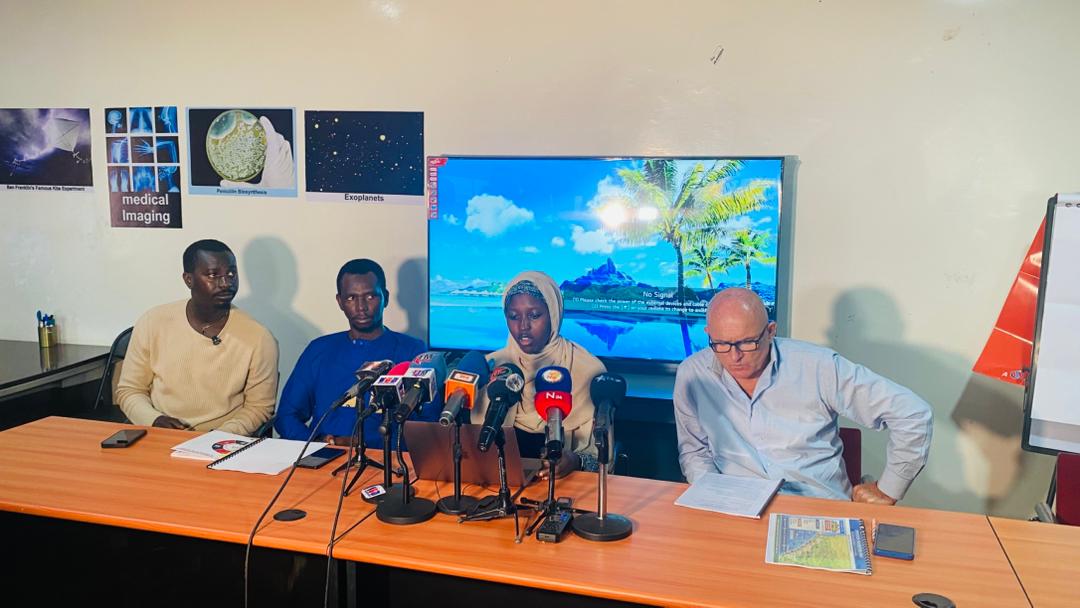
At a somber press conference Monday at the National Youth Parliament in Banjul, activists and humanitarian groups released what they described as the most detailed independent data yet on Gambian migration—a grim accounting that lays bare the scale of loss devastating families and communities nationwide.
Ebrima Drammeh, widely known as Ebrima Migration Situation, presented the findings. “Seven hundred and thirty Gambians died missing at sea. Seventy-four are missing on land. This is different from anything we have seen before,” Drammeh told those gathered.

- Gambia Navy Intercepts Migrant boat as Nation Reels from Unhealed Wounds of Deadly ‘Backway’ Departures | The Senegambia Observer
- President Barrow Mourns Boat Tragedy, Renews Call Against Irregular Migration | The Senegambia Observer
- New Smuggling Route Exposed as GID Intercepts 70 Migrants | The Senegambia Observer
According to the Ebrima Migration Situation Foundation and the African Migration Advisory Centre, 2025 saw 69 migrant boats leave Gambian shores. Only 24 made it to Spain. Forty-five were stopped, but despite the dangers, 6,173 Gambians reached Europe last year—5,119 landing in Spain, another 1,054 in Italy.
Presumed Dead After 49 Days
The press conference turned especially emotional when the African Migration Advisory Centre formally declared a “humanitarian presumption of death” for the roughly 119 people who left Jinnack Island on November 17, 2025, and haven’t been heard from since.
“For 49 days, families have waited. They have listened for phones to ring. They have lived in silence and in pain,” said Adriane Corish of the Advisory Centre.
“There is no medical, scientific, or operational plausible scenario under which anyone on this vessel could still be alive.”
Organizers said the declaration was meant to give families the truth and a measure of dignity, allowing them to begin mourning after weeks of agonizing uncertainty.
Boats Keep Leaving
Despite the rising death toll, departures haven’t stopped. “In just six days, from December 1st to today, 592 people have arrived in Spain on three boats,” Drammeh said, naming Batokunku, Barra, and Banjul as their points of departure.
He added that two Gambians—one from Busa, one from Barra—died shortly after landing in Tenerife. “I spoke with their families yesterday,” Drammeh said quietly. “They all lost their life there.”
Government Faces Criticism
Speakers at the event harshly criticized the Gambian government, accusing officials of playing down the crisis. Madi Jobarteh, of the Edward Francis Small Centre for Rights and Justice, called recent government statements on migration “misleading” and dangerous.
“The fundamental issue should be what the government is doing to confront this matter,” Jobarteh said. “All indications are that if the government is doing anything, it’s far too little. Boats are leaving. Communities are losing dozens of their sons and daughters.”
He questioned the purpose of security forces stationed along the coast. “You have police in Banjul. You have the Navy in Banjul. Boats leave Banjul. What are those police stations or security forces doing to allow this to pass?”
Social Media’s Role
Social media, especially TikTok, was singled out as a major factor driving young Gambians to risk the journey. Speakers warned that misinformation is fueling dangerous choices.
“Misinformation and the narrative have to change,” Corish said. “Young people are leaving their homes without even telling their parents.”
He explained that migrants in Europe, even some in detention, post photos online—smiling outside, posing with cars or apartments—giving a false impression of life abroad. “Yet their liberty is taken.”
Corish argued that the real battle is in education, calling for migration awareness to be taught in schools.
“If you’re making a life-and-death decision based on TikTok or Facebook, then something is wrong. The battleground for all of this is in schools.”
Root Causes
Jobarteh said the crisis goes deeper than border control or awareness campaigns. It’s about governance and opportunity. “At the end of the day, you have to build a system that lets citizens earn a living and find jobs—especially young people.”
Even educated Gambians, he noted, are leaving because services and prospects are poor. “How many Gambians just want to leave because services are just poor?”
The activists also called on Europe to acknowledge its role, pointing to the continent’s aging population and need for workers.
“Europe’s demographics are changing. Their population is getting older. Africans need jobs. Europe is looking for workers,” Corish said.
“They should embrace Africa more than just react to migration.”
A Plea to the Youth
The event ended with a call for Gambian youth to take a leading role in shaping the response to the crisis.
“Maybe the time has come for the youth to sit with the President face to face and have a serious conversation about the situation of the youth in this country,” Jobarteh said.
“Youth have to take responsibility for not being bystanders. They are the majority in this country.”
The organizations pledged to keep tracking migration data independently and pushing for policy reform. Without urgent action, they warned, the deaths will continue—and the humanitarian emergency will only deepen.