

By Biran Gaye
The Gambia Navy has intercepted another boat packed with migrants heading for Europe, officials said Sunday, 4th January 2026. The latest bust highlights just how relentless irregular migration remains—even after a string of recent tragedies and tighter crackdowns.
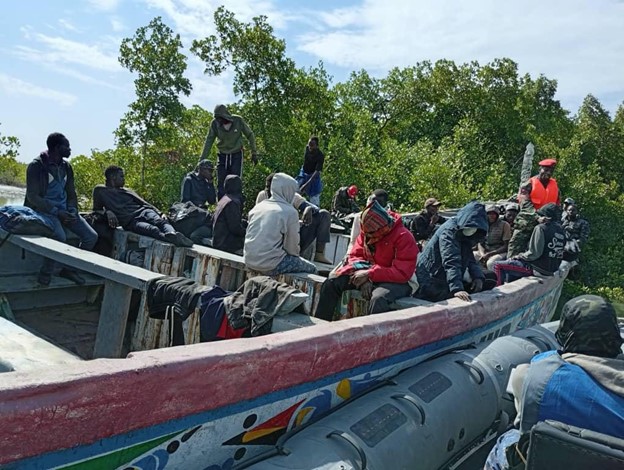
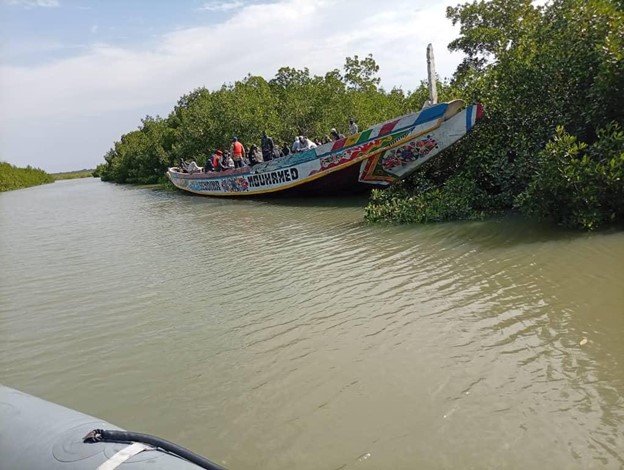
According to a statement posted on the Gambia Armed Forces’ official Facebook account, the Navy’s Riverine Coastal Detachment intercepted a local canoe carrying potential migrants in the creeks along the Bunyado coastal area early on Sunday morning, 4th January 2026.
The operation cut short yet another attempt to brave the Atlantic—a route that has already claimed countless Gambian lives.
This latest interception comes on the heels of a tragic rescue just days ago, when the Navy pulled more than a dozen survivors from a capsized boat that had left Jinack. That disaster left several dead and forced a scramble to aid the traumatized survivors, pushing the death toll from these journeys even higher.
- President Barrow Mourns Boat Tragedy, Renews Call Against Irregular Migration
- 𝐖𝐚𝐭𝐜𝐡: President Barrow express concern over lost lives in boat disasters along Gambia coast
Despite these tragedies, the boats keep launching. In recent weeks, several migrant vessels have departed Gambian shores for Spain, with mixed outcomes: some made it to Europe, others were intercepted by navies from The Gambia, Mauritania and Senegal.
The so-called “backway” is the illegal migration route used mostly by West African youth hoping for a better life in Europe.
The trip is notoriously dangerous, with overcrowded, barely seaworthy boats making the long, risky crossing to Spain’s Canary Islands—a voyage that can take days, sometimes weeks, and often ends in catastrophe.
For many young Gambians, the backway is a desperate last resort in the face of bleak job prospects at home. The risks—death, exploitation, deportation—are well known, but the lack of opportunity leaves few alternatives.
The Gambian government has poured money into technical and vocational training centres, hoping to give young people employable skills. But critics say these efforts fall short, arguing that graduates get little real support to turn training into steady work.
As Madi Jobarteh, a human rights activist, put it: “A serious government would have invested massively in youth-focused institutions. The National Youth Council, NEDI, PIA, NSC, and similar institutions should have been resourced to scale up. Youth entrepreneurship should have been backed by accessible financing, low interest credit and market support.”
Too many are still left with no way to make a living.
The International Organization for Migration (IOM) is trying to tackle part of the crisis. Its Assisted Voluntary Return and Reintegration program helps returnees with support and psychosocial services. But these efforts only reach those who’ve already risked everything—the root causes remain untouched.
As the departures keep coming, officials and activists are beginning to sound the alarm. “It is clear that a different, collective approach is needed to reduce the number of boats departing from the Gambian coastal communities,” says migration activist, Ebrima Drammeh, calling for a strategy that addresses both enforcement and the deep-seated economic issues driving migration.
The Navy says it’s committed to ramping up patrols along the River Gambia estuary to block more boats from leaving. But it’s clear that patrols alone can’t stop desperate young people from chasing a better future—no matter the cost.
The Gambia’s struggle is part of a wider regional crisis. Across West Africa, poverty, unemployment, political turmoil and climate pressures are forcing thousands to risk the perilous Mediterranean and Atlantic routes each year.
Sunday’s interception is a win for law enforcement—but it’s also a reminder that real change will require more than just naval muscle. Lasting progress depends on economic development, job creation and regional teamwork to offer Gambian youth a future that doesn’t start with a dangerous trip across the sea.