
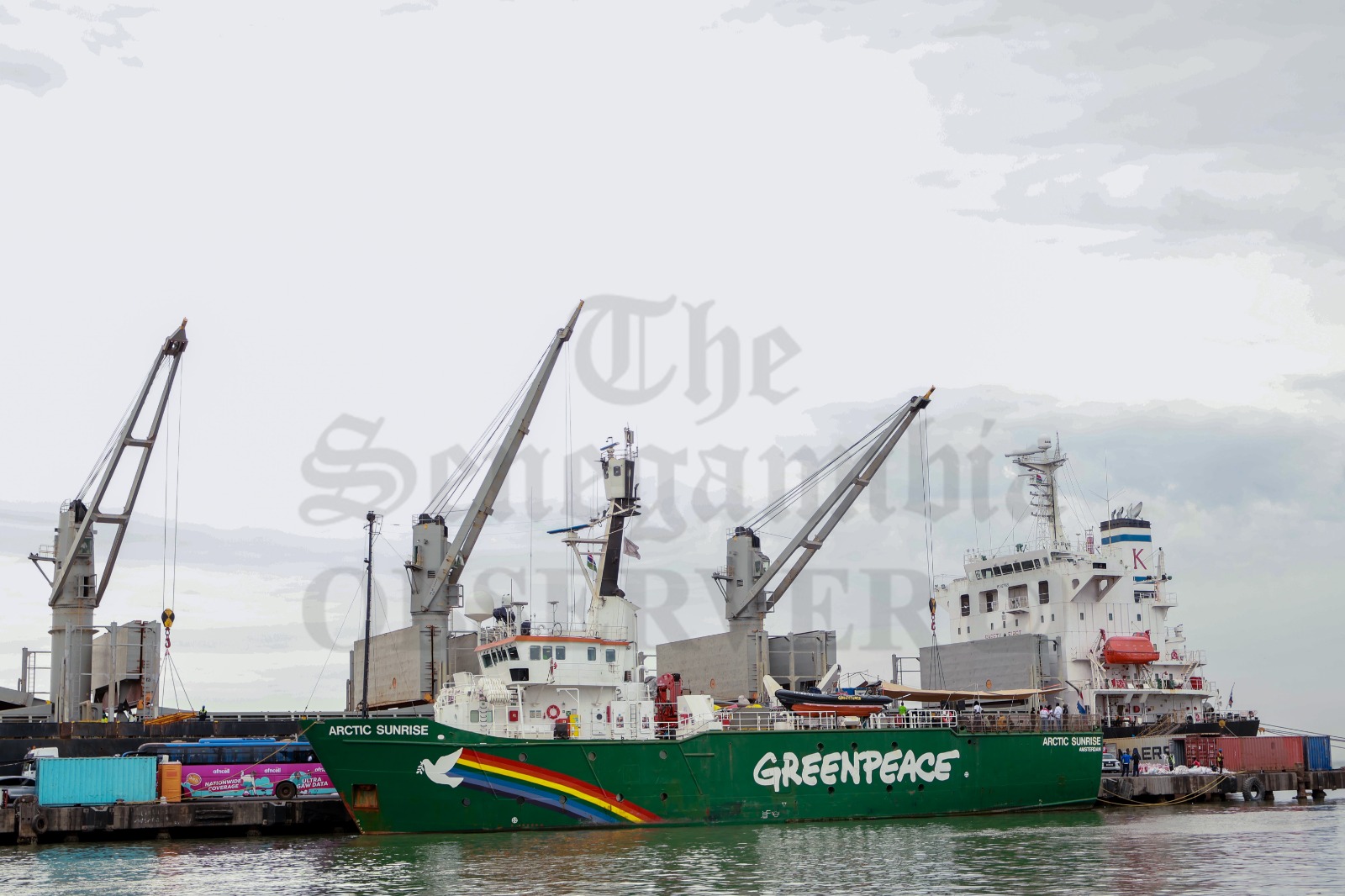

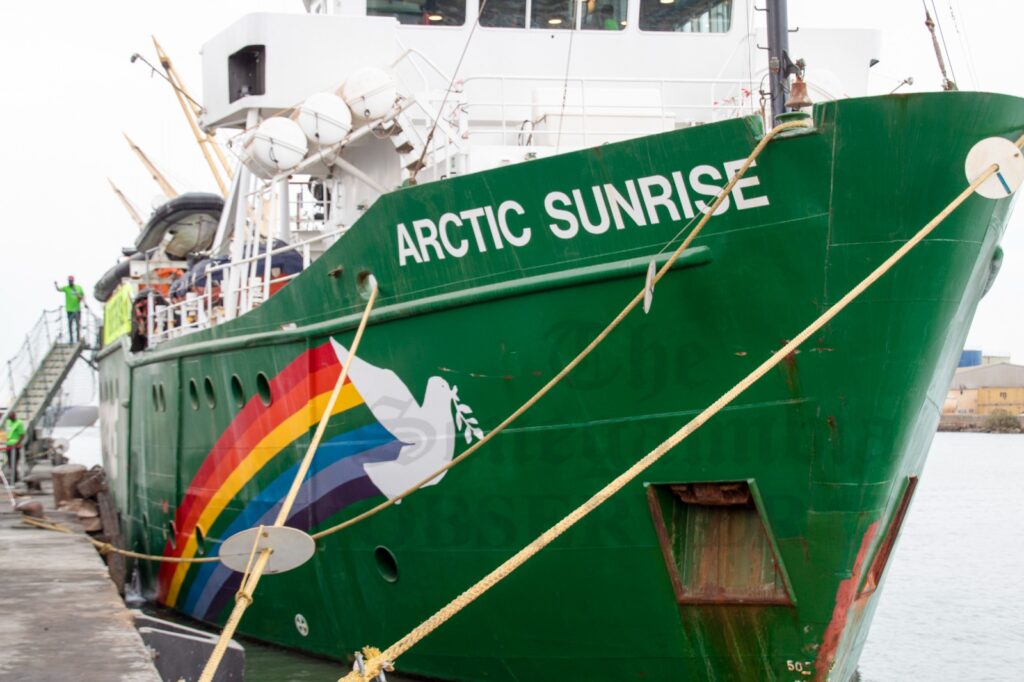
It’s not every day that the Banjul Ports play host to a ship with a history as storied as the Arctic Sunrise. When our crew from The Senegambia Observer arrived at the docks, the Greenpeace vessel was unmissable — squat, bright, and bristling with energy, a floating beacon for environmental defenders and curious onlookers alike.
The air buzzed with anticipation as we climbed aboard, joining a steady stream of Gambian students, local activists, and fishermen eager for a closer look. For many, this was their first time stepping onto a ship that has braved polar ice and political storms, all in the name of protecting the planet’s most fragile places.
On deck, we met Captain Mike Fincken— a man whose life is stitched together by decades at sea and a relentless commitment to the cause. He greeted us with an easy smile and the kind of calm that only comes from forty years navigating the world’s waters.
“I am Captain Mike from the Arctic Sunrise – the Greenpeace boat in Banjul. My job is to bring the Greenpeace ships around the world. I’ve been doing this for 30 years and it is an honour to be here in The Gambia to look at the fisheries.”
This visit, he told us, is deeply personal. “This is my 5th time in the area with Greenpeace and we’ve been following, reporting overfishing, illegal fishing in the region.
“It is a wonderful opportunity now to join locals and to try and create a network in the whole Western African region to bring fisheries, the fish in the land, to Africa – rather than disappearing to distant shores. And we need to do this.
“I’ve been at sea for 40 years this year, with Greenpeace for 30 years, to build a better place for our children to follow our footsteps. They’ll have an opportunity to explore and to have a beautiful life as we have had in our present time.”
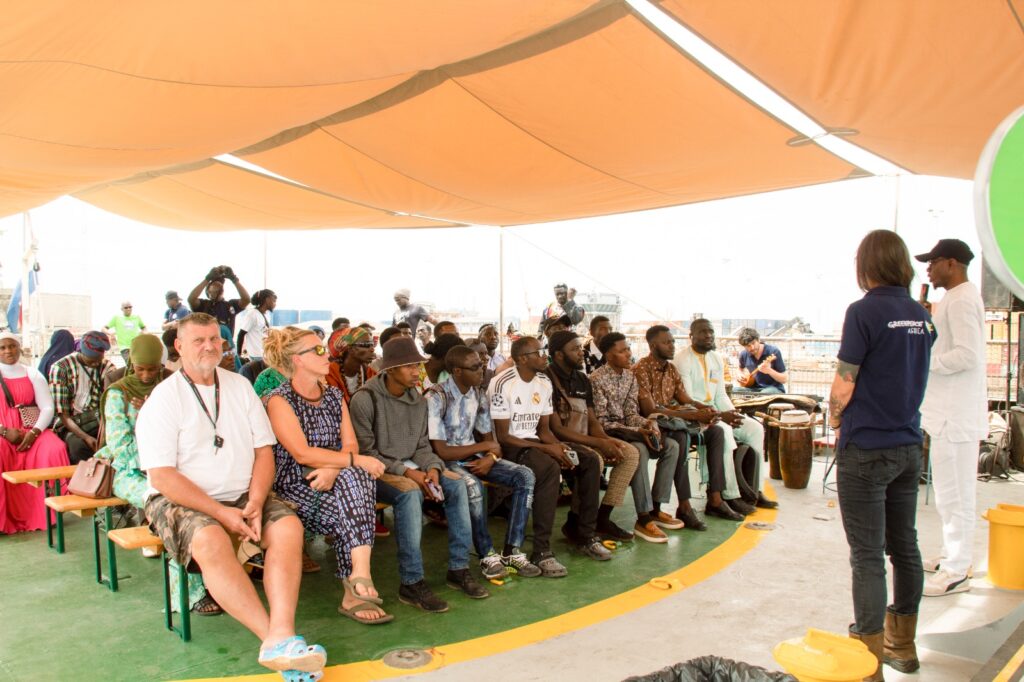
On deck, we joined a group discussion led by Dr. Aliou Ba, campaign lead for Greenpeace Africa. Dr. Ba’s passion is unmistakable, his sense of responsibility to local communities clear in every word.
“So we’re in here today to work with communities, the government, to highlight the importance of the oceans for our lives, especially for coastal communities,” he told us.
“Most of the communities who live around the coastal area rely on fisheries and the ocean for their daily livelihoods – to feed their families and for income. That is why it is important to save the ocean.”
He didn’t mince words about the threats facing the region. “West African countries are losing a lot to illegal fishing. Millions of dollars are missing,” Dr. Bah said.
Greenpeace, he explained, works closely with coastal communities not just to raise awareness, but to provide training and capacity building so that locals can protect their own waters.
“We will also be going to the high sea to show the communities what is also happening there. Activities are happening there that threaten biodiversity.”
“We have a good relationship with coastal communities in the area of coastal protection and we collaborate in a lot of our work, training and capacity building.”
— Dr. Aliou Ba, Greenpeace Africa
For many Gambians, the visit is a chance to be heard. Saikou Dibba, an environment activist from Bakau, put it simply: “For years, we’ve watched foreign trawlers take our fish, while our parents come home with empty nets. Having this ship here, seeing Greenpeace stand with us — it makes us feel seen. It gives us hope.”
The ship itself seemed to hum with purpose. Every corner told a story — a wall of photographs from past campaigns, a laboratory cluttered with sample jars and notebooks, the faded Greenpeace logo painted on the hull.
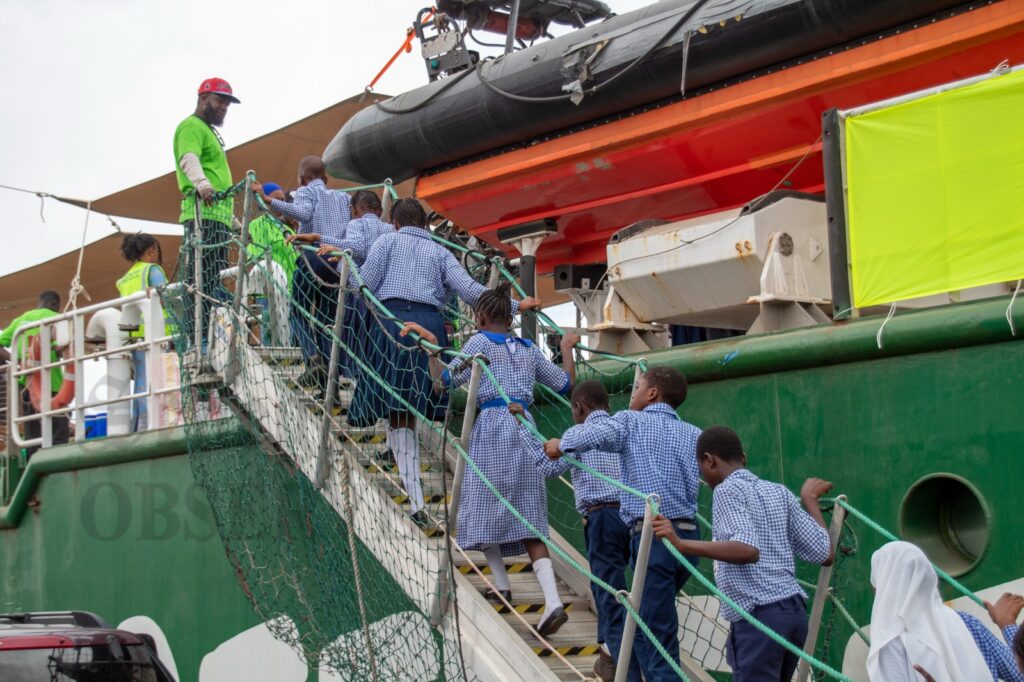
Schoolchildren clustered around the bridge, peppering the crew with questions about whales, storms, and the nuts and bolts of life at sea. At a corner of the deck a tent was erected to serve as a meeting point, where a group of environmental NGOs sketched out new strategies for raising awareness and pushing for stronger enforcement of local fishing laws.
As the sun dipped low over Banjul, painting the river gold, the Arctic Sunrise stood ready to sail onward, carrying with it the hopes and voices of those it had met along the way. Our team left the ship inspired not just by its legacy, but by the determined optimism of everyone aboard.
The message, from captain to campaigner to local activist, was clear: if the fight for West Africa’s fisheries is to be won, it will be won together — with courage, with collaboration, and with the world watching.