
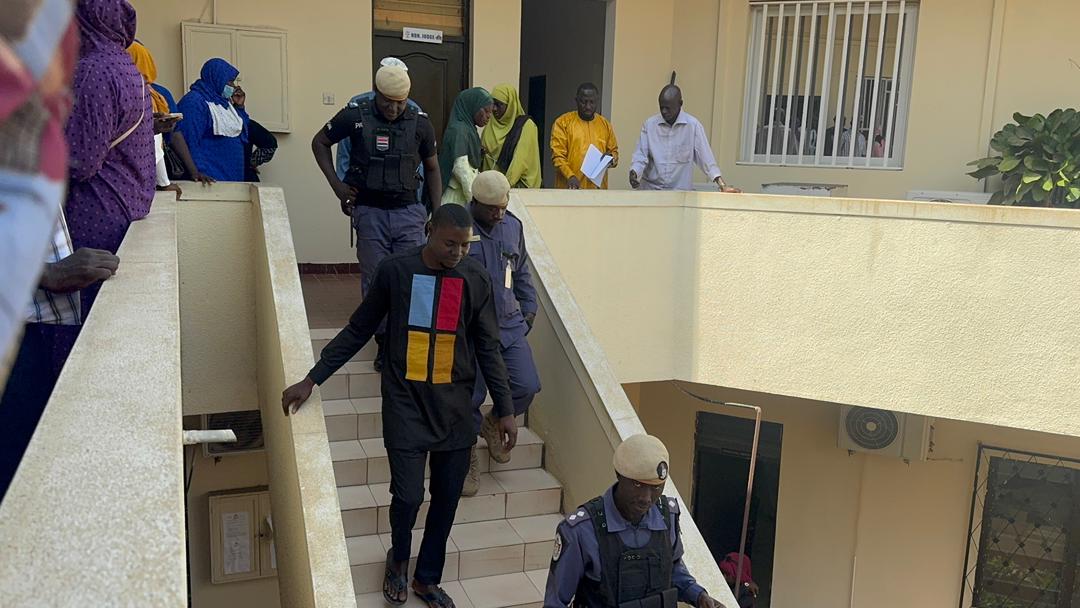

Justice Ebrima Jaiteh, in his ruling at the high court, has acquitted and discharged Ousainou and Amie Bojang, as he ruled that the prosecution failed to prove its case beyond a reasonable doubt in the high-profile Sukuta-Jabang shooting trial.
In a detailed judgment, the Court held that the central issue was whether the Prosecution had sufficiently established the guilt of the accused persons, particularly in light of weak identification evidence, disputed confessional statements, and the first accused’s alibi.
Justice Jaiteh reaffirmed the fundamental principle of criminal law that the burden of proof lies solely on the Prosecution and must be discharged beyond a reasonable doubt.
While the Court accepted that the two police officers died from gunshot wounds, it found no credible and consistent evidence linking Ousainou Bojang to the killings.
Judge Jaiteh highlighted serious contradictions in witness testimonies, noting that key eyewitnesses gave conflicting descriptions of the alleged shooter and failed to make a positive identification, adding that the only surviving officer also could not identify the attacker, further weakening the Prosecution’s case.
The Court also dismissed the alleged confessional statements as unreliable, citing inconsistencies, lack of corroboration, and investigators’ failure to comply with legal safeguards, including the mandatory video recording requirement under the Anti-Terrorism Act.
Central to the ruling was the alibi presented by Ousainou Bojang, which the Court found to be consistent and strongly corroborated by multiple witnesses and documentary evidence.
Justice Jaiteh faulted the Prosecution for failing to properly investigate the alibi, describing the investigative process as inadequate and, in parts, flawed.
On the charge against Amie Bojang, the Court held that the Prosecution failed to prove she had knowledge of any crime or that she intentionally assisted in evading justice. Justice Jaiteh noted that without proof of the principal offence, the charge of accessory after the fact could not stand.
Justice Jaiteh further pointed to significant gaps in the investigation, including the absence of forensic evidence, failure to conduct a proper identification parade, and reliance on weak and inconsistent testimonies.
He concluded that the cumulative effect of these deficiencies created reasonable doubt, which must be resolved in favour of the accused.
Both Ousainou Bojang and Amie Bojang were therefore acquitted and discharged on all counts, with the Court noting that the State retains the right to appeal the decision.