
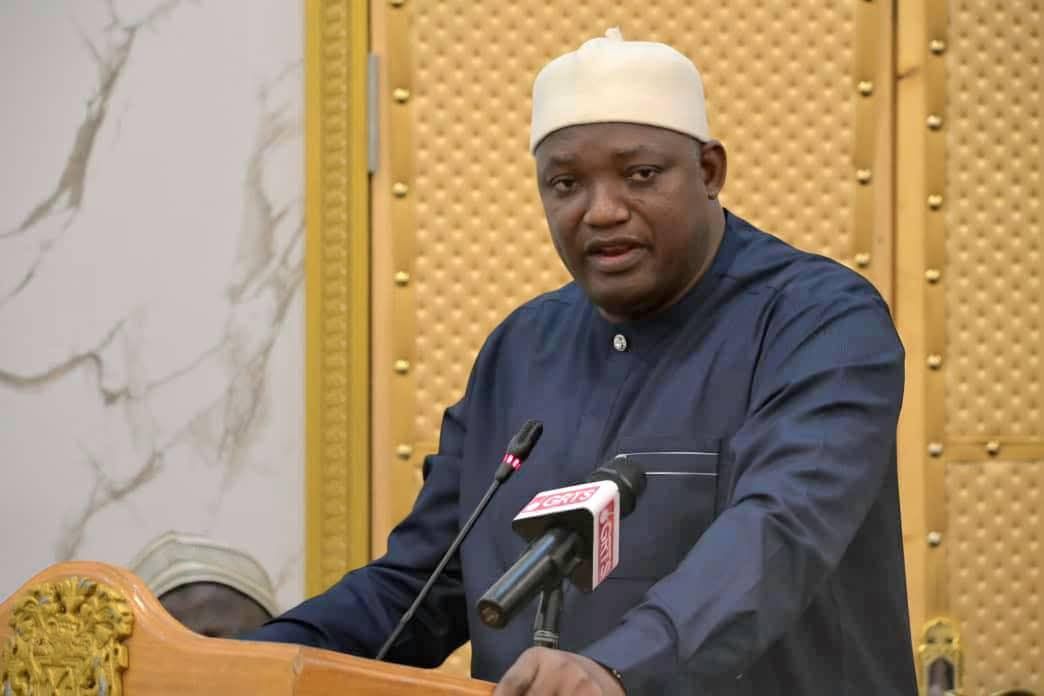

Questions about President Adama Barrow’s declared assets, expensive residences and stewardship of public institutions are intensifying as Gambians contend with power cuts, rising living costs and anxiety over the country’s political direction.
When Adama Barrow took the presidential oath, he promised to protect The Gambia’s Constitution, serve its people and prevent personal interests from influencing his official decisions.
Nearly a decade later, that promise is under growing scrutiny.
Former senior members of Mr Barrow’s government, including people who once served near the centre of power such as Vice-President, have publicly questioned his leadership and competence. Their criticism has added to a broader crisis of confidence shaped by economic hardship, repeated electricity failures and persistent concerns about the independence of state institutions.
The dispute is no longer confined to party politics. It now reaches the central question facing The Gambia: do the country’s institutions still have the independence and authority to hold a president accountable?
For many Gambians, the controversy centres on Mr Barrow’s personal wealth. In a sharply worded opinion piece widely published on Gambian-related media outlets, Economist and author Musa Bassadi Jawara argues that President Adama Barrow has lost the credibility required to govern.
A widely followed Gambian political analyst Pa Njie Girigara has also released a statement in the form of a WhatsApp voice note, urging President Barrow to return Fajara state land and hold the adviser behind the mansion plan accountable. Their claims remain allegations, but they add to a wider debate about presidential wealth, public institutions and the integrity of The Gambia’s next election.
When President Barrow submitted his nomination papers to the Independent Electoral Commission in 2021, he reportedly declared assets valued at D200m. That disclosure came roughly four years after he assumed office in January 2017, following the electoral defeat and eventual departure of former leader, Yahya Jammeh.
The declaration has prompted questions about the sources of the president’s wealth. Those questions have grown louder as images of large residences associated with Mr Barrow have circulated publicly.
Photographs and informal property estimates cannot prove corruption. Nor does the ownership of an expensive home, by itself, establish that a law has been broken. Yet a president is not an ordinary private citizen. When a head of state accumulates or declares substantial wealth while in office, the public is entitled to ask how it was acquired.
Mr Barrow should provide a complete account of his assets, liabilities, business interests and sources of income before and during his presidency. That account should be examined by a genuinely independent authority and made available to the public, subject to legitimate privacy and security considerations.
If his wealth was acquired lawfully, transparent disclosure would help answer his critics. If it cannot be adequately explained, the appropriate investigative and prosecutorial bodies should act.
A Constitution Designed to Prevent Private Enrichment
The Constitution imposes clear obligations on the holder of the presidency.
Under the presidential oath contained in Schedule 2 of the 1997 Constitution, the president promises to protect the sovereignty and integrity of the republic, defend the Constitution and administer justice “without fear or favour, affection or ill will.” The oath also requires the president not to allow personal interests to influence official conduct or decisions.
Section 68(4) goes further. It restricts a serving president from holding other remunerated positions or engaging in most forms of private business, aside from specified agricultural activities. It also prohibits conduct that creates a conflict between official responsibilities and private interests.
Most significantly, the provision says that a president must not use the office—or information obtained through it—to enrich himself or another person.
These provisions do not prove that Mr Barrow has violated the Constitution. They do establish the standard against which his conduct must be measured. They also make financial transparency a constitutional concern rather than a matter of political curiosity.
The relevant question is therefore not whether the president appears wealthy. It is whether his assets can be reconciled with his lawful income and constitutional obligations.
That question should be answered with financial records, tax documents, property registries and an independent audit—not speculation, partisan rhetoric or social-media photographs.
Bright Residences, Darkened Communities
The controversy surrounding presidential wealth has become more potent because it coincides with a prolonged electricity crisis.
Across The Gambia, unreliable power affects nearly every part of daily life. Shopkeepers risk losing refrigerated goods. Small businesses spend scarce money on generators and fuel. Students struggle to read after sunset. Health facilities must protect vaccines, medicines and medical equipment from interruptions in supply.
For households already under financial pressure, electricity failures impose another layer of cost. Families must buy candles, charge lamps or pay for alternative sources of power. Businesses often pass their generator and fuel expenses to consumers, contributing to higher prices.
Against this background, images of brightly illuminated residences associated with the president have acquired political meaning. The contrast is difficult to ignore: visible private comfort set against public scarcity.
The anger is not simply about lighting. It reflects a belief that those who govern are insulated from the failures experienced by ordinary citizens.
NAWEC, the national water and electricity utility, has become a symbol of that divide. Its difficulties are often discussed as technical problems involving generation capacity, fuel supplies, infrastructure and debt. But the crisis also raises questions about management, procurement, political interference and accountability.
Gambians deserve a public explanation of NAWEC’s finances, its contractual obligations and the reasons it has been unable to deliver dependable service. They also deserve to know who benefited from major contracts and whether those agreements represented value for public money.
Institutions Under Pressure
Concern extends beyond the electricity sector.
Public confidence has also weakened around institutions responsible for ports, telecommunications, law enforcement and elections. Critics of the administration say these bodies have been subjected to political pressure and used to advance the interests of a small group connected to power.
Such claims require investigation. Yet the perception alone is damaging.
Institutions rely on more than statutory authority. They depend on public belief that rules will be applied consistently. Once citizens assume that investigations can be stopped, contracts manipulated or electoral decisions influenced, even lawful government actions become difficult to trust.
The Independent Electoral Commission occupies a particularly sensitive position. Allegations surrounding the distribution of public money after the previous election—and claims that a police investigation identified potential grounds for prosecution—have not been adequately resolved in the public mind.
If those allegations are inaccurate, the relevant institutions should publish enough information to explain why. If evidence of misconduct was found, the public should be told whether charges were considered, why they were not pursued and who made that decision.
Institutional silence rarely ends a controversy. More often, it allows suspicion to harden into accepted belief.
Economic Pain Deepens the Anger
The political strain comes as many Gambians struggle with the cost of basic goods.
Rice, cooking oil, transport, rent and electricity consume a large share of household income. Civil servants and other salaried workers find that their earnings buy less each month. Small traders face high operating costs, limited access to affordable credit and uncertainty caused by unreliable infrastructure.
The combination of hardship and visible wealth among political leaders is combustible in any country. It is especially dangerous in a democracy where institutions remain fragile and memories of authoritarian rule are recent.
Mr Barrow entered office as the leader of a coalition that promised democratic renewal after more than two decades under Mr Jammeh. His presidency was meant to mark a break with personal rule and the use of state institutions to protect those in power.
That history makes the present questions more serious. Gambians did not remove one entrenched political order merely to accept another.
The Election Question
Calls to postpone the presidential election scheduled for December 5th have emerged from fears that weakened institutions cannot guarantee a credible contest.
Those fears should not be dismissed. An election administered by institutions that lack public confidence could produce unrest, prolonged litigation and a disputed result. In a deeply polarised environment, even routine administrative failures can be interpreted as deliberate manipulation.
Yet postponement is not a simple cure.
An election cannot lawfully be delayed merely because citizens distrust the government or electoral authorities. Any postponement would need a clear constitutional basis, judicial oversight and broad political agreement. Without those safeguards, delaying the vote could create the very constitutional breakdown that proponents say they want to prevent.
The urgent task is therefore to determine whether the election can be made credible within the remaining time.
The voter register should be independently examined. Electoral procedures and results-management systems should be published and tested. Political parties should receive equal access to essential information. Domestic and international observers should be permitted to monitor every stage of the process, including voter registration, campaigning, polling, counting and dispute resolution.
State resources must not be used to favour the incumbent. Security forces must remain politically neutral. Courts must be ready to hear electoral complaints promptly and independently.
If credible experts determine that these minimum protections cannot be achieved, all lawful options may need to be considered. But postponement must not become a device for extending anyone’s tenure or avoiding the judgment of voters.
The President’s Choice
Mr Barrow now faces a decision that goes beyond political survival.
He can respond to questions about his wealth and record with disclosure, independent scrutiny and institutional reform. Or he can continue to rely on official silence, partisan defence and the power of incumbency.
The first course may be uncomfortable, but it offers a path towards restoring public confidence. The second risks deepening suspicion and pushing the country towards a confrontation that may become difficult to contain.
Resignation is a serious constitutional step and should not be demanded casually. Still, if the president cannot satisfactorily account for his wealth, permit independent investigations and guarantee a credible election, his continued tenure will become increasingly difficult to defend.
Leaving office under constitutional procedures would be less damaging than presiding over the collapse of public trust.
International partners, including ECOWAS, the African Union, the European Union, the Organisation of Islamic Cooperation and the United Nations, should monitor the situation closely. Their role is not to choose The Gambia’s government. It is to support constitutional order, credible elections and the independence of public institutions.
The most important responsibility remains with Gambians themselves: legislators, judges, journalists, civil-society groups, religious leaders, public servants and voters.
This moment requires evidence rather than rumour, law rather than vengeance and courage rather than silence.
The questions raised by the president’s declared assets and residences will not disappear because officials refuse to answer them. Nor will the electricity crisis, economic pain and erosion of institutional trust be solved through speeches.
The Gambia’s democratic transition was built on the belief that no public official should stand above the Constitution. That principle is now being tested at the highest level of government.
The properties associated with the president may have raised the questions. Only transparent records can answer them. And only independent institutions can ensure that the answers carry consequences.