
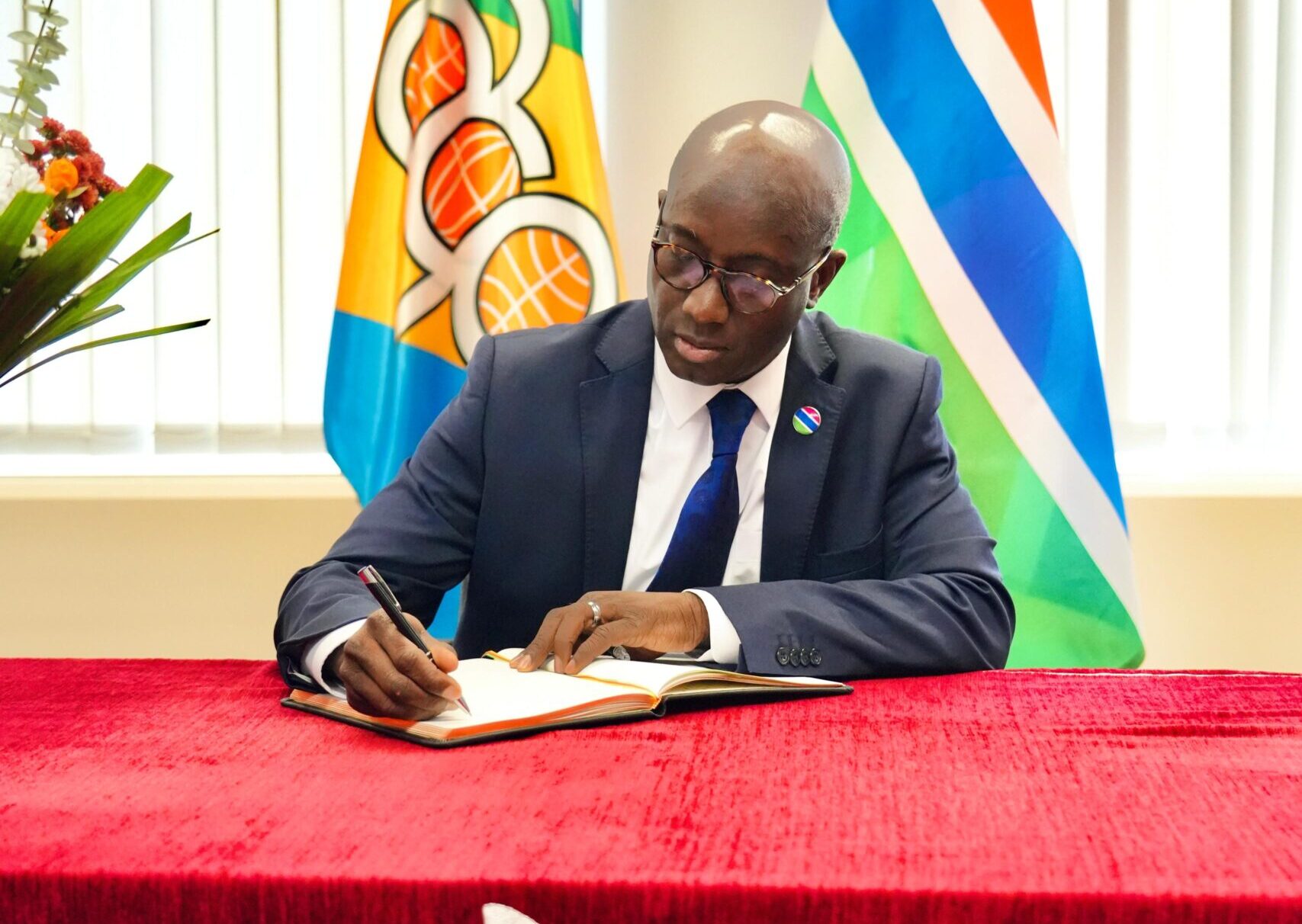

The Gambia has assumed the presidency of the Council of Ministers and chairmanship of the Committee of Ambassadors of the Organisation for African, Caribbean and Pacific States (OACPS).
The Brussels-based body announced this in a press release following a handover ceremony on February 2, 2026.
The West African nation will hold the rotating leadership position for six months, through July 31, 2026, taking over from Solomon Islands at a hybrid ceremony held at OACPS headquarters.
Honourable Seedy KM Keita, Gambia’s Minister of Finance and Economic Affairs, accepted the Council of Ministers presidency from Solomon Islands’ Foreign Affairs and External Trade Minister Peter Shanel Agovaka.
In a parallel transition, Ambassador Pa Musa Jobarteh, Gambia’s representative to Belgium and the EU, assumed the Committee of Ambassadors chairmanship from Solomon Islands Ambassador Moses Kouni Mose.
The Council of Ministers serves as the implementing body for guidelines established by the organisation’s Summit of Heads of State, while the Committee of Ambassadors provides ongoing oversight between ministerial meetings.
During its tenure, Gambia has outlined five key priorities: supporting governance reforms within the OACPS, strengthening member state confidence in the organisation, ensuring robust preparation and participation for the upcoming 11th Summit of Heads of State, advancing implementation of the Samoa Agreement with the European Union, and overseeing the 2026 secretariat budget.
The next summit is scheduled for March 27-29, 2026, in Equatorial Guinea, with numerous presidents and foreign ministers already confirmed to attend.
Founded in 1975, the OACPS brings together 79 member states—48 from sub-Saharan Africa, 16 from the Caribbean, and 15 from the Pacific—with the collective goal of promoting sustainable development and the economic, social and political well-being of their populations.
The organisation operates through five main organs: the Summit of Heads of State, which convenes every three years as the highest decision-making body; the Council of Ministers; the Committee of Ambassadors; the Secretariat; and the Joint Parliamentary Assembly, which provides political oversight.
For most member states, including Gambia, finance ministers serve as the designated officials responsible for managing the organisation’s development cooperation relationship with the European Union.