
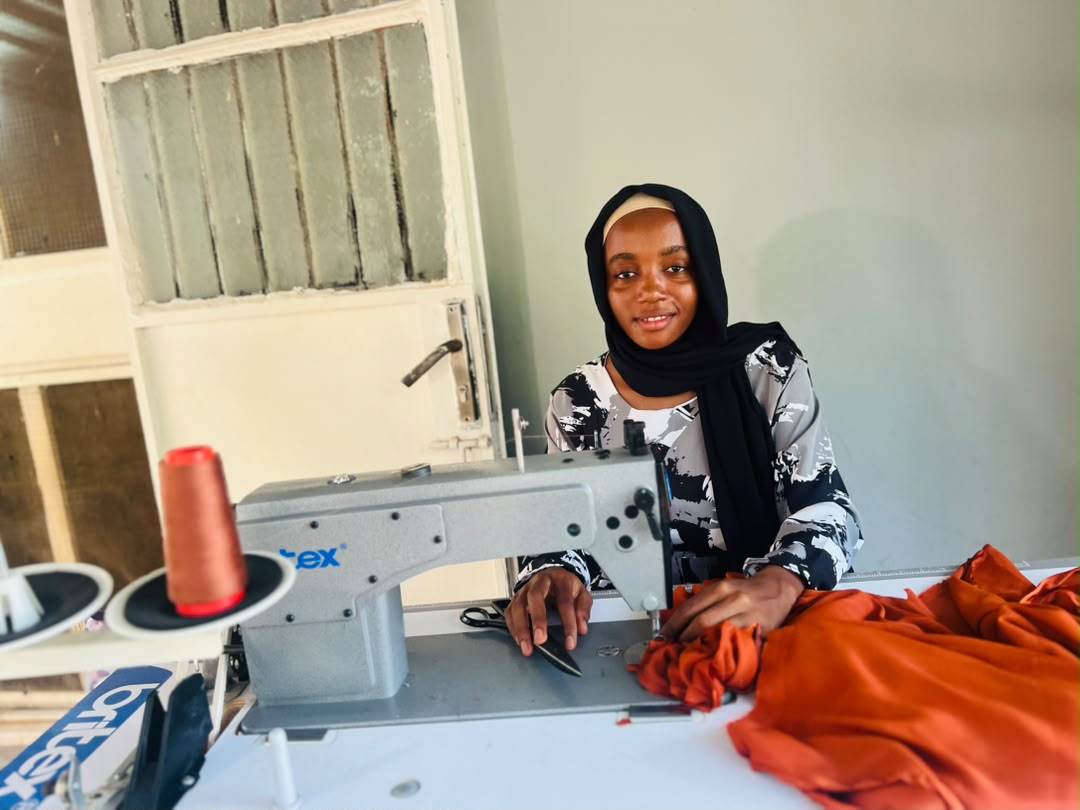

A SWEDD+ grant has helped the Bakoteh seamstress grow her customer base. Now she hopes to open a larger shop and employ other young women.
By Jankey Touray
BAKOTEH, The Gambia — When Fatou Banja finished school in 2020, her results were not what she had hoped for. She chose another way forward: learning to sew.
“I began tailoring training in 2021 through the Youth Empowerment Project,” she said. Nine months of training led to a three-month industrial attachment at a tailoring shop in Kololi. She still works there, while taking on customers from her home in Bakoteh.
The training gave Banja a skill, and she had a sewing machine. What she did not have was enough capital to build the business she wanted. Without it, growing her customer base and establishing herself as an independent tailor proved difficult.
A D25,000 payment — the first tranche of a grant from the Sahel Women’s Empowerment and Demographic Dividend Plus project, known as SWEDD+ — has helped ease that pressure.
“I lacked capital when I started, but the SWEDD+ grant has helped me attract more customers,” Banja said.
The extra business means more than an income for herself. Banja also uses what she earns to support her mother. She wants her experience to show other young women that a disappointing school result need not close off their options.
“What a man can do, a woman can do too,” she said.
Banja is building her business in a labour market where women face substantial barriers. The Gambia Bureau of Statistics’ 2025 Labour Force Survey put women’s labour force participation at 40.9 per cent, against 53.8 per cent for men. It also found that 86.3 per cent of employed women worked informally, compared with 76.7 per cent of employed men.
Through SWEDD+, the Ministry of Gender, Children and Social Welfare, working through the Women Enterprise Fund, provides entrepreneurship training, grants and mentorship to vulnerable adolescent girls and young women. Project officials said 2,064 young women joined the first training group; 1,977 completed the programme and met the requirements for grant support. The government has committed D117 million in start-up grants for 2,064 out-of-school and vulnerable adolescent girls and young women nationwide.
Fatou Dampha, an enterprise development officer at the ministry, said Banja’s customer base has grown significantly since she received the grant. The programme’s follow-up mentorship is intended to help recipients address business challenges and keep their enterprises going.
Banja’s plans reach beyond the work she does now in Kololi and at home. She hopes to open a larger tailoring shop and hire young women, including those who have left school or struggled with their results.
“Even if you drop out of school or get poor results, a skill can take you far in life,” she said.