

By Abdoulie Jawo
It’s just after six in the evening, and the streets of Serrekunda are humming with quiet urgency. Women in headscarves and men in kaftans hurry home, arms loaded with baguettes, bags of dates and plastic bottles of ‘wonjo’ juice. A few blocks away, in a small church, the last bars of an evening hymn drift out into the warm dusk. For once, the rhythms of these two scenes are perfectly synchronised.
This year, The Gambia finds itself in the unusual position of hosting both Ramadan and Lent simultaneously—a rare overlap in the calendars of Islam and Christianity that has made the country a living symbol of religious coexistence.
In a country where roughly 95 per cent of people identify as Muslim and a small but vibrant Christian minority makes up much of the rest, these twin periods of fasting and reflection have always been part of the national mood. But when they fall together, something special happens.
The Long Fast
Ramadan, the holiest month in Islam, is a time of fasting from sunrise to sunset, prayer, charity, and self-restraint. For Christians, Lent is also a season of fasting and repentance—a 40-day journey leading up to Easter.
Both are about more than just skipping meals. They’re about discipline, spiritual renewal, and, perhaps most importantly in The Gambia, community.
On the surface, the routines are different. Muslims rise before dawn for ‘suhoor’ (early morning meal) and break their fast at sunset with iftar (evening meal for breaking fast).
Christians give up meat or sweets, avoid parties, and spend extra time in prayer. But the feeling in the air is much the same: a kind of collective hush, as if the whole country is holding its breath and waiting for something bigger than itself.
In the mornings, the markets are a bit quieter, and the chatter on the minibuses is softer. By late afternoon, everyone is watching the clock—Muslims eager for the maghrib call to prayer, Christians headed to Lenten services. There’s a sense that everyone is in it together, whatever “it” may be.
Sharing the Table
For Molifa Drammeh, a baker at Tabokoto junction, the overlap means twice as many customers. “During Ramadan, people want bread and cakes for iftar,” he says, “but this year, my Christian customers are also coming to buy for Lent.
“They can’t eat meat, so they buy more bread and fish pies.” He laughs. “It’s good business for me, but it’s also nice. We all understand each other’s traditions.”
Pierre Stevens Prierra is a Christian. His friend Aboubacarr Darboe (B.B) who lives in Sukuta, a Muslim, invites him for ‘Ndogu’ (Iftar ). He grew up celebrating both Islamic festivities and Lent with his Muslim friends.
“ For me it’s the sermons. The Imams and the Priests have been preaching that there is a cordial relationship between these two religions”, he said.
“The Christians and Muslims have very important values they share, and other countries emulate each time they see us accepting one another,” Paul claims.
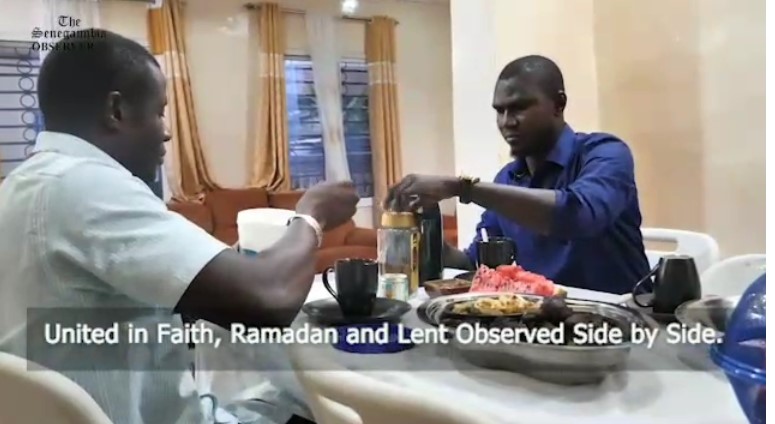
“Now, when Lent and Ramadan come together, we share food at iftar and invite each other for Lenten suppers. We also stay late at work and let those fasting – whether Christian or Muslim – go home early to fulfill their religious obligations. It’s a way of showing respect.”
This mutual hospitality is woven into the fabric of Gambian life. During Easter, it’s not unusual for Christian families to send ‘Nan-buru’ (baobab rice pudding), sweets or cold drinks to their Muslim neighbors at sunset, or for Muslims to join Christians in prayer for peace. The lines between the two communities are porous, and most Gambians are proud of it.
Faith in Tolerance
The government, too, has made a point of celebrating this overlap. President Adama Barrow, himself a Muslim, has called on Gambians to use this time to “pray for unity and understanding.” And for many, the country’s reputation for religious tolerance is a point of national pride—a kind of quiet rebuke to the turmoil that has torn apart other nations in the region.
Of course, there are challenges. The economic pressures of fasting—especially when both communities are observing at the same time—can strain families already struggling to make ends meet. And while The Gambia is known for its peace, religious harmony is never something to be taken for granted.
But for now, the mood is hopeful. As dusk falls and the call to prayer echoes through the city, the streets fill with the smells of breaking fast: fried fish, ‘Benachin’ (Jollof rice), stewed oyster, ‘Mborr-Mborr’ (local tea), dates, fresh bread.
A few doors down, the ‘Muezzin’ (one that calls Muslims to prayer) calls out the faithful to Isha (evening prayer). For a few precious weeks, the two great faiths of The Gambia are walking side by side.
In a world so often divided by religion, this is no small thing. Here, at least, the long fast—whether for Ramadan or Lent—is a reminder that, sometimes, the hardest journeys are the ones best taken together.