
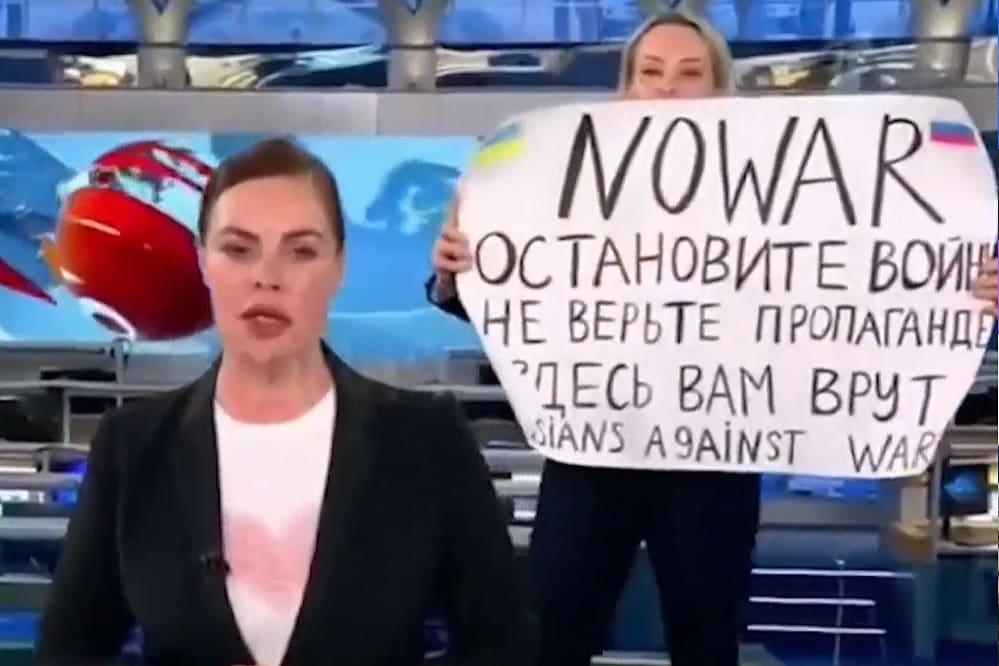

On the evening of March 14, 2022, viewers of Russia’s most-watched news programme were jolted by a rare scene: a woman, Marina Ovsyannikova, burst onto the Channel One set during a live broadcast, holding a sign denouncing Russia’s war in Ukraine. Her banner read, “They are lying to you,” and she cried out, “No to war.” Within moments, her defiant act swept across news outlets worldwide—and became a symbol of dissent in a country where speaking out can have heavy consequences.
A Protest That Made Headlines Worldwide
International media responded quickly. The story led broadcasts and front pages from CNN and BBC to France 24, Al Jazeera, and Spain’s EL PAIS. ITV in the UK, for instance, ran the headline: “Russian journalist interrupts live TV state media broadcast with ‘no war’ protest.” Their coverage, like many others, highlighted the risks Ovsyannikova faced under new Russian laws criminalising criticism of the military—punishable by up to 15 years in prison.
The Guardian and The Independent focused on the legal aftermath, reporting Ovsyannikova’s court appearance and the 30,000-rouble fine imposed for a video she recorded before her protest—described as a “relatively light sentence” given Russia’s climate of repression. The BBC profiled her courage and examined cracks emerging in the Kremlin’s narrative.
Across the Atlantic, VICE and The Washington Post published striking images of her on-air protest. CNN gave extensive coverage to her 14-hour detention and the video message she published before her TV appearance.
France 24 called her protest “a daring act of dissent,” while EL PAIS in Spain delved into the risks she faced and reactions from both the Kremlin and Russian media. Turkey’s TRT World noted that Ovsyannikova was not alone—other Russian celebrities who condemned the invasion also faced public backlash and, in some cases, left the country.
Al Jazeera’s headline read: “Russia on-air protester fined, faces possible prison term,” and the network broadcast Ukrainian President Volodymyr Zelensky’s message of thanks to Ovsyannikova.
Russian Media Responds with Censorship and Denial
Inside Russia, the state news agency TASS reported only that authorities were “investigating a woman” who disrupted a broadcast—without naming Ovsyannikova or quoting her message. The independent newspaper Novaya Gazeta published a censored image of her, blurring out the words on her sign, a testament to the tightening grip of censorship.
Kremlin spokesman Dmitry Peskov dismissed the protest as “hooliganism” and refused to discuss it further. This mirrors the broader clampdown on independent reporting in Russia since the invasion began, as described by multiple analysts and journalists interviewed for this essay.
Propaganda, Disinformation, and the Challenge for Journalists
The climate for journalists in Russia has become ever more hostile. New laws have made it almost impossible to report independently on the war. “President Putin is pulling all the stops to maintain a monopoly on information in Russia,” said Cynthia Hooper, a professor of Russian and Eastern European Studies.
John Bruni, an international affairs analyst, argued that Putin’s reliance on state-run media echoes the information control seen in autocratic regimes of the past. Yet, as Wendy Sloane, a journalism professor at London Metropolitan University, pointed out, many Russians support Putin not out of ignorance, but as a result of decades of state messaging and historical experience. She noted that millions rely on state TV as their main news source.
Sloane also highlighted the dilemma facing foreign correspondents: with access so tightly controlled, verifying facts is increasingly difficult. Fact-checking has become a top priority for newsrooms, but the sheer volume of social media material—often posted by ordinary people—makes the job harder than ever.
Digital news editor Adam Parker of Sky News described the challenge: “The key aspect is location, which enables us to build a bigger picture around the footage.” Footage sometimes comes from unverifiable sources, complicating efforts to separate fact from fiction.
The “information war” has also empowered ordinary people. As one analyst put it, “You can follow Russia’s invasion of Ukraine in real time, but you can also join in.” Yet this power can be abused. Viral stories like the “Ghost of Kyiv” have spread quickly, even when their truth is questionable—sometimes amplified inadvertently by mainstream outlets.
A Divided Reaction to Ovsyannikova’s Courage
Ovsyannikova’s actions were widely praised outside Russia as brave and principled. Some critics, especially within Russia’s opposition press, questioned her years of work for state TV, but most agreed her protest carried significant personal risk.
Some journalists, like Joshua Yaffa of The New Yorker, cautioned against seeing her act as eclipsing the ongoing bravery of those who remain at independent outlets under severe threat.
Meanwhile, as Western and independent Russian outlets scrambled to cover the story, many reporters were forced to leave the country or work anonymously to protect themselves and their sources.
Conclusion: Reporting Truth in an Age of Propaganda
Marina Ovsyannikova’s protest was a rare breach in Vladimir Putin’s fortress of information control. For a brief moment, the world saw dissent on Russian state TV. International coverage praised her courage, while the Kremlin painted her as a criminal. Her story highlights the immense challenges journalists face in Russia today: censorship, propaganda, disinformation, and the constant risk of punishment for telling the truth.
In an age when propaganda spreads as quickly as facts and independent voices are under siege, Ovsyannikova’s act—and the world’s reaction to it—reminds us why journalism matters, and why it is so fiercely contested in times of war.
This article was first written by Lamin S Jaiteh as an MA, International Journalism research Essay at City, University of London in 2022.