

By Biran Gaye
A new opinion poll reveals widespread dissatisfaction among Gambian voters ahead of the December 2026 presidential election. The survey shows concerns about economic performance, corruption, and electoral integrity.
The Centre for Policy, Research and Strategic Studies (CepRass) conducted the poll. They surveyed 1,245 eligible voters across all regions. The poll was funded by the National Endowment for Democracy.
The poll used a multi-stage stratified random sampling method and digital data collection tools. The sample was drawn from the recent national SDG Survey.
Concerns About Third Term
The survey reveals that President Adama Barrow’s quest for a third presidential term remains a major concern among Gambians.
Fifty-eight per cent of respondents said a third term would weaken democracy, according to Think-Tank CepRASS. Only 17 per cent said it would strengthen democracy. Another 15 per cent said it would have no impact.
The results varied by region. In Basse, 67 percent said a third term would weaken democracy. In Kuntaur, 61 per cent shared this view.
Trust in President Limited
Trust in the current president appears limited. Only 16 percent of respondents said they trust the president “a lot” to act in the nation’s best interest.
Thirty-seven percent said they trust him “not at all.” Another 26 percent said they trust him only “somewhat.”
Approval ratings tell a similar story. Thirty-five percent of respondents said they “strongly disapprove” of how the president is handling his job. Twenty-one percent said they “somewhat disapprove.” Only 12 percent said they “strongly approve.”
Economic Dissatisfaction Runs High
Economic concerns dominate voter worries. Thirty-nine percent of respondents said the government is handling the economy “very badly.” Another 21 percent said “fairly badly.” Only four percent said “very well.”
Job creation shows similar problems. Forty-three percent said the government is handling jobs “very badly.” Twenty-three percent said “fairly badly.” Only four percent said “very well.”
Regional differences emerged in these views. In Kanifing, 50 percent said the government handles the economy “very badly.” In Mansakonko, 49 percent shared this view.
Corruption Fight Seen as Weak
The survey unveils that most voters believe the government is failing to fight corruption. Forty-seven percent said the government is handling corruption “very badly.” Nineteen percent said “fairly badly.” Only four percent said “very well.”
This represents one of the lowest-rated areas of government performance. The findings suggest voters want stronger anti-corruption measures.
Institutional Reform Lagging
Voters also expressed disappointment with institutional reforms. Forty-four percent said the government is handling institutional reform “very badly.” Twenty-one percent said “fairly badly.” Only four percent said “very well.”
National unity received similarly low marks. Forty-seven percent said the government is performing “very badly” on unity. Twenty percent said “fairly badly.”
Comparing Current to Past Leaders
CepRASS says most respondents believe the current president is performing worse than previous presidents.
Thirty-two percent said he is doing “worse.” Twenty-six percent said “much worse.” Only eight percent said “much better.”
Electoral Reforms Demanded
Voters strongly support electoral reforms.
“Eighty-four percent want term limits reintroduced. Ninety-three percent support diaspora voting rights. Sixty-five percent want paper ballots adopted.
“These findings show voters want comprehensive electoral integrity measures. They seek constitutional safeguards and stronger enforcement against malpractice,” it noted.
Confidence in 2026 Election Mixed
Confidence in the upcoming election is not strong, the poll reveals. Twenty-nine percent said they are “not very confident” the 2026 election will be free and fair. Sixteen percent said “not at all confident.” Only 18 percent said “very confident.”
Regional variations appeared here too. In Kuntaur, 46 percent said they are “not very confident.” In Basse, 45 percent expressed similar doubts.
“Meet the People Tour” Seen as Political
Voters view the president’s “Meet the People Tour” as a political campaign tool, the survey finds. Fifty percent “strongly agree” it has become a political event rather than a governance activity. Another 22 percent “agree.” Only five percent “disagree.”
This perception was strongest in Kanifing, where 55 percent strongly agreed. It was also high in Brikama at 50 percent.
Social Media Plays Major Role
Findings noted that social media has become important for political information. Seventy-six percent of respondents have access to social media platforms. This includes Facebook, WhatsApp, TikTok, and YouTube.
“Access varies by region. In Banjul, 86 percent have social media access. In Basse, only 58 percent do,” CepRass finds.
“Forty-one percent of voters use social media daily for political news. Another 21 percent use it several times weekly.
TikTok emerged as the most-used platform for political information. Facebook and WhatsApp follow closely.”
However, trust in social media information is limited. Forty-five percent said they have “moderate” trust. Only eight percent said “very high” trust. Fifteen percent said “none.”
Voter Registration Strong
Despite concerns about governance, voter participation remains high. Eighty-one percent of respondents currently have valid voter cards.
Ninety-two percent said they intend to register for the 2026 election.
This shows broad readiness to participate. Women showed slightly higher commitment than men. Urban areas and older demographics showed minor dips.
Confidence in Electoral Commission Cautious
Public confidence in the Independent Electoral Commission (IEC) is mixed. Only 23 percent expressed “a lot” of confidence. Twenty-four percent said “somewhat.” Another 24 percent said “a little.”
This trust gap could impact perceptions of election legitimacy.
Views on Past Elections Divided
Thirty-seven percent of respondents said past elections were “free and fair with minor problems.” Twenty-one percent said “not entirely free and fair.”
Sixteen percent said “not free and fair.” Only 17 percent said “completely free and fair.”
Young people and educated groups showed more doubts about electoral integrity.
Current Race Competitive
The poll suggests a competitive race ahead. Thirty-four percent said they would vote for the current president.
Forty-nine percent said they would vote for another candidate. However, another 14 percent said they don’t know. This large undecided group could determine the outcome.
NPP Alliance Leads Party Preferences
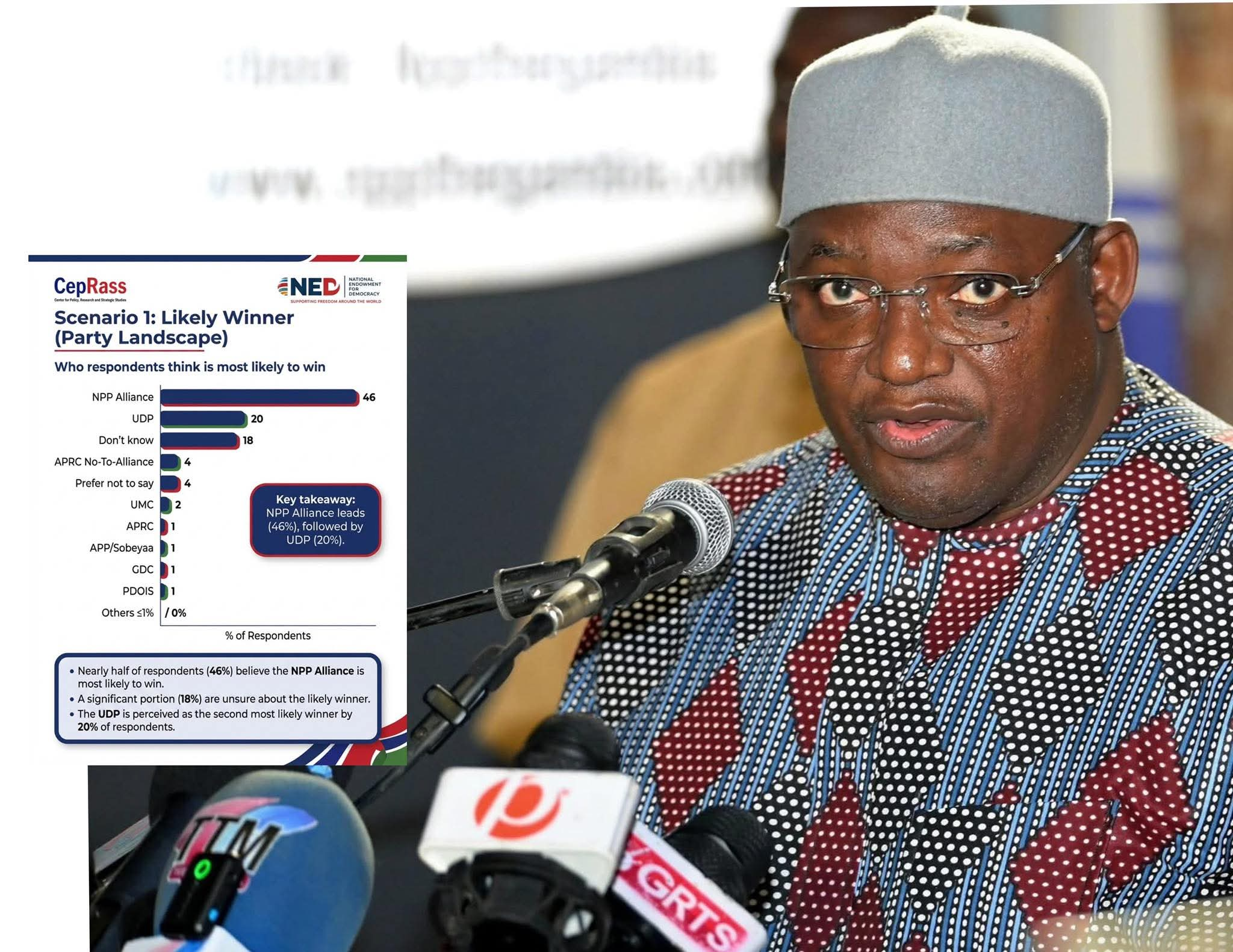
When asked which party will likely win, 46 percent said the NPP Alliance, according to CepRASS. Twenty percent said the United Democratic Party (UDP).
However, 18 percent said they don’t know or prefer not to say.
Among opposition preferences, UDP leads with 35 percent support. The All People’s Congress (APRC) follows with 14 percent. PDOIS has 11 percent.
Coalition Seen as Key
Most voters, CepRASS noted, believe a united opposition coalition is necessary to defeat the incumbent. Sixty-nine percent said “yes” to this question. Only 25 percent said “no.”
This view was consistent across regions. In Kanifing, 72 percent supported a coalition approach. In Kerewan, 71 percent agreed.
Recommendations
The report recommends several actions for political leaders, which include engagement of undecided voters with policy-based campaigns rather than rhetoric.
“They should address economic dissatisfaction and unemployment with concrete job creation programs,” the Think Tank advises political entities.
The report also calls for stronger anti-corruption bodies. It recommends more transparent public spending. It urges reforms to strengthen the IEC’s independence.
“Political leaders should promote national unity and inclusion. They should support responsible journalism while protecting press freedom,” the organisation calls on politicians.
The findings show voters want responsive governance and leaders who listen to citizen concerns and translate public opinion into action.