

By Biran Gaye
Before daylight reaches Tabokoto, Sukuta Conteh, 39, is already up. The town still feels restless, but inside the modest home she shares with her four children, the race is on — breakfast, uniforms, chores, a quick sweep of the compound.
By the time most of the Greater Banjul residents are awake, she’s by the dusty roadside, prepping her small charcoal pot, ready for another day.
Tabokoto, about 17 kilometres from the capital, is much more than a drab transit hub; it’s a hive of passing life.
Hundreds of people move through every day: traders, students, tired workers, and — like Conteh — vendors who depend on that daily surge of humanity for their survival.
Street vending is everywhere here: makeshift stalls, tiny tables, trays balanced on heads weaving through traffic.
For The Gambia, this is the economy’s undercurrent — necessary, vital, yet mostly ignored.
Vendors like Conteh stitch together a living, even as they weather unreliable infrastructure and the sort of “support” from authorities that often disappears when it’s really needed.
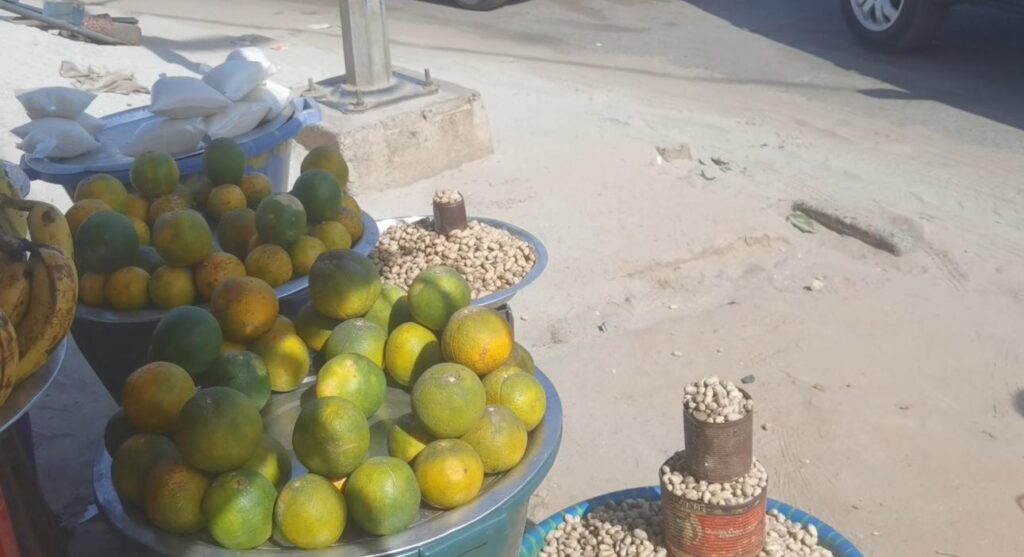
Her hands, toughened by years of roasting groundnuts, are the quiet record of how she’s turned peanuts into possibility.
On a good day, Conteh brings home D300 — roughly $4. It’s not much, but it’s enough to keep her kids in school, to buy lunch. She’s matter-of-fact about it: “With the meagre daily income of almost D300 from my peanut sales, I stepped in to help pay children’s education and their daily lunches.”
There’s that blend of pride and exhaustion in her voice, a common note among street vendors here.
Her days look much the same, echoing a rhythm shared by countless others hustling on the margins of the formal economy. Early chores. Children off to school.
Then the familiar trek to her spot along Tabokoto road. Sparks from her charcoal fire catch the waking breeze, and soon the scent of roasting peanuts drifts out to seize the attention of passing commuters.
Today, she sells more than usual: D300, a little extra because a friend is out sick. “We help each other here — cover for one another when someone has to leave.
Everybody’s in it together,” she says. There’s a quiet solidarity on this strip of pavement.
Still, Conteh and others like her are largely invisible in the bigger plans mapped out by the Kanifing Municipal Council (KMC).
“We pay D10 a day as levies, but we don’t get the services,” she says. Bins are scarce, collection trucks unreliable, and so vendors pay again — this time to donkey cart operators to haul away their refuse.
Every extra dalasi for trash collection is a dalasi not going to rent, food, or school.
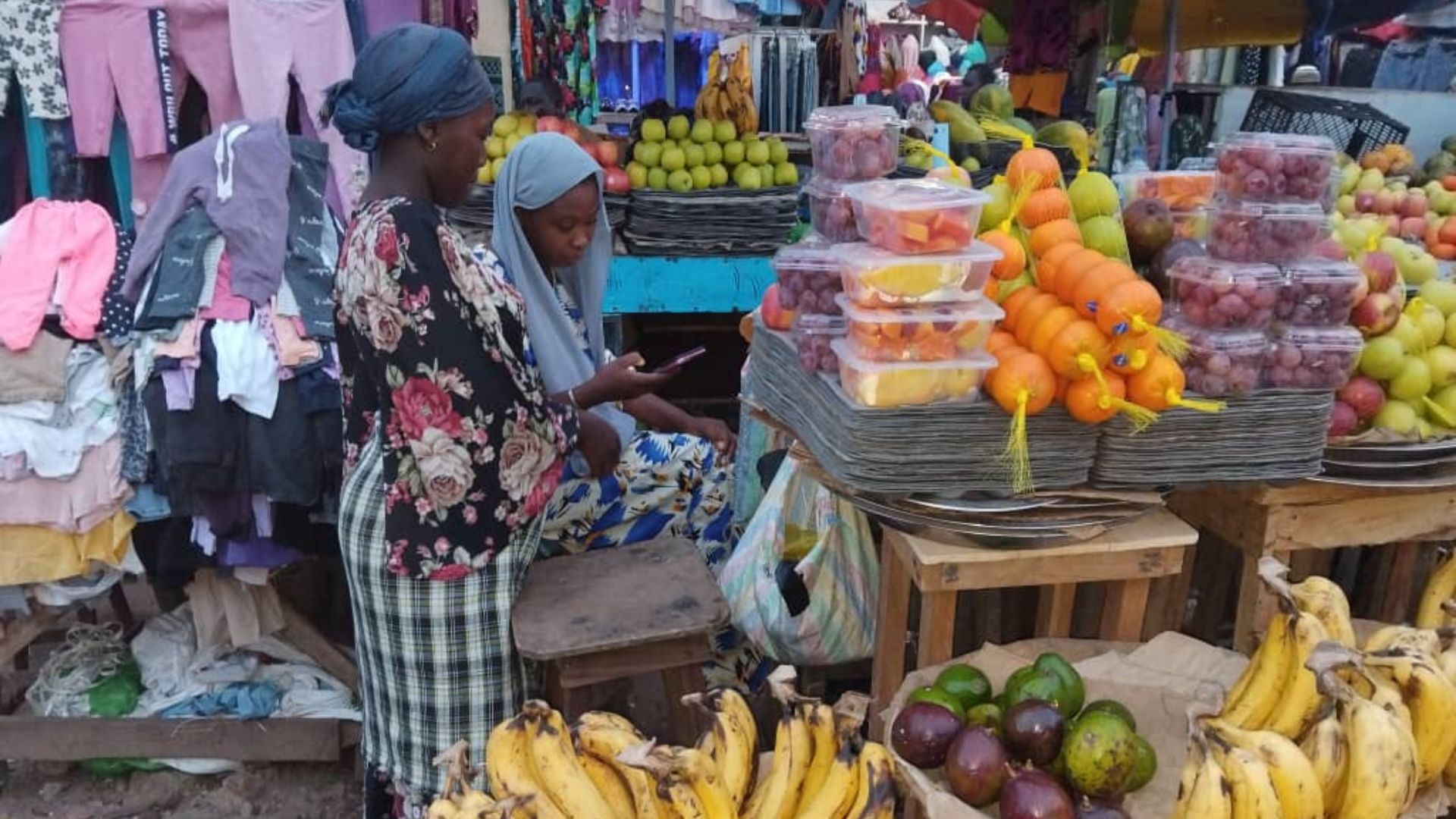
Along the same artery, Muctarr Jallow, 40, tends a battered fruit stall shaded by an umbrella and loaded with apples, bananas, pineapples, and the fat, striped watermelons that survive the heat.
“A small apple costs D35 — most Gambians can’t afford that, so sales are slow,” he explains.
“It used to be better when we imported fruits directly, but now everything passes through Senegal and costs are up because of currency changes.”
He and his brother man the stall in shifts, day and night. Despite paying the KMC for waste and levies, services don’t trickle down.
“They don’t give us bins. Waste just piles up here,” he says, waving at the heap of peels and rinds gathering at his feet, a visible risk to his wares.
Hit the Play button below and listen (in Wollof) to a fruit seller talk about his stall and challenges he faces as a roadside vendor.
 Over in Wellingara, in the West Coast Region — another teeming crossroad just beyond Serrekunda — Jainaba Jallow and her son clear away a day’s worth of fruit and peanut sales as the light fades.
“With this business, I am thankful,” she says, arranging the last of the day’s produce under her metal roof.
Even gratitude comes tinged with worry: “If I had support, I’d build a bigger canteen, stock it properly, and do more for my family.” The work is relentless, and rewards are always just enough, never more.
All of these lives — Conteh’s, Jallow’s, Bah’s — feed into a bigger truth. Informal vendors form a critical backbone of The Gambia’s economy.
The Central Bank estimates that close to 60% of national employment is informal; the World Bank says over 40% of GDP comes from this sector.
Women and young people fill most of these roles, selling produce, paying relatives’ school fees, and keeping families afloat — all fuelled on razor-thin margins.
Peanut sellers, fruit hawkers, women with trays of groundnuts: together, they move between D150 million and D200 million through the local economy every year.
That money becomes uniforms, doctor bills, and bowls of rice. But the challenges hold steady: no access to credit, unreliable facilities, almost no social safety net, and persistent hardship where basic dignities — like waste services, water, or trading licenses — are luxuries, not assumptions.
World Bank research shows more than 80% of Gambian informal workers lack even basics like dustbins or clean water at work.
Most want little more: some dustbins, predictable trash collection, maybe a shot at a microloan.
“Dustbins, just to keep the place clean, that’s all we’re asking,” Jallow says, voicing an almost universal plea.
Experts and advocates are pushing for more: proper support from municipal officials, the creation of vendor cooperatives, real training programs.
If unleashed, this sector could be something formidable.

At the Latrikunda Sabiji Market entrance, where street noise swells and falls, 25-year-old Kadijatou Bah stands guard over a neat trailer of bananas, pawpaws, apples, each day’s batch perched on cardboard.
For Bah, fruit business is an act of survival — a leap of resilience. “Sales used to be better. Now, fruit is getting more expensive and customers are fewer.
Some days, you just carry everything back home,” she says, resigned, determined.
Refrigeration is her dream — some way to keep fruit from spoiling before she can sell it. But ice boxes and electricity are out of reach for a roadside stall.
Like others, she pays for waste pick-up herself because the municipal trucks don’t come.
“There is never a dustbin, and the Mbalit (garbage) trucks are rarely here,” she says, paying out of her earnings for private trash collection.
Even regulars like Fatoumatta Bitaye, a mother, notice the pinch: “Prices are up, but these vendors are still the most affordable. My family counts on them.”
Customer Musa Ceesay, another regular, insists on buying from the street stalls: “They need our support.
Things are tough for them, especially since most fruits come through Senegal and cost more.”
Despite these daily hurdles, vendors continue to pay their levies — D10 per day, per person, silently building the foundation of municipal budgets.
Vending here is never just a job. It’s food, school, medical care, and hope for something better.
As morning creeps back across Banjul, Tabokoto, Latrikunda, Wellingara, Conteh and thousands of others steel themselves for another bruising, hopeful day.
Their effort, often invisible, is what keeps The Gambia moving — quietly, reliably, against the odds.